History & overview · every faith gets one
There is no god but God — and life is submission to that fact.
The religion of surrender to the one God, revealed through the Quran to Muhammad, the final prophet in a line reaching back through Jesus and Moses to Abraham. Nearly two billion people order their days around its five pillars.
The revelation
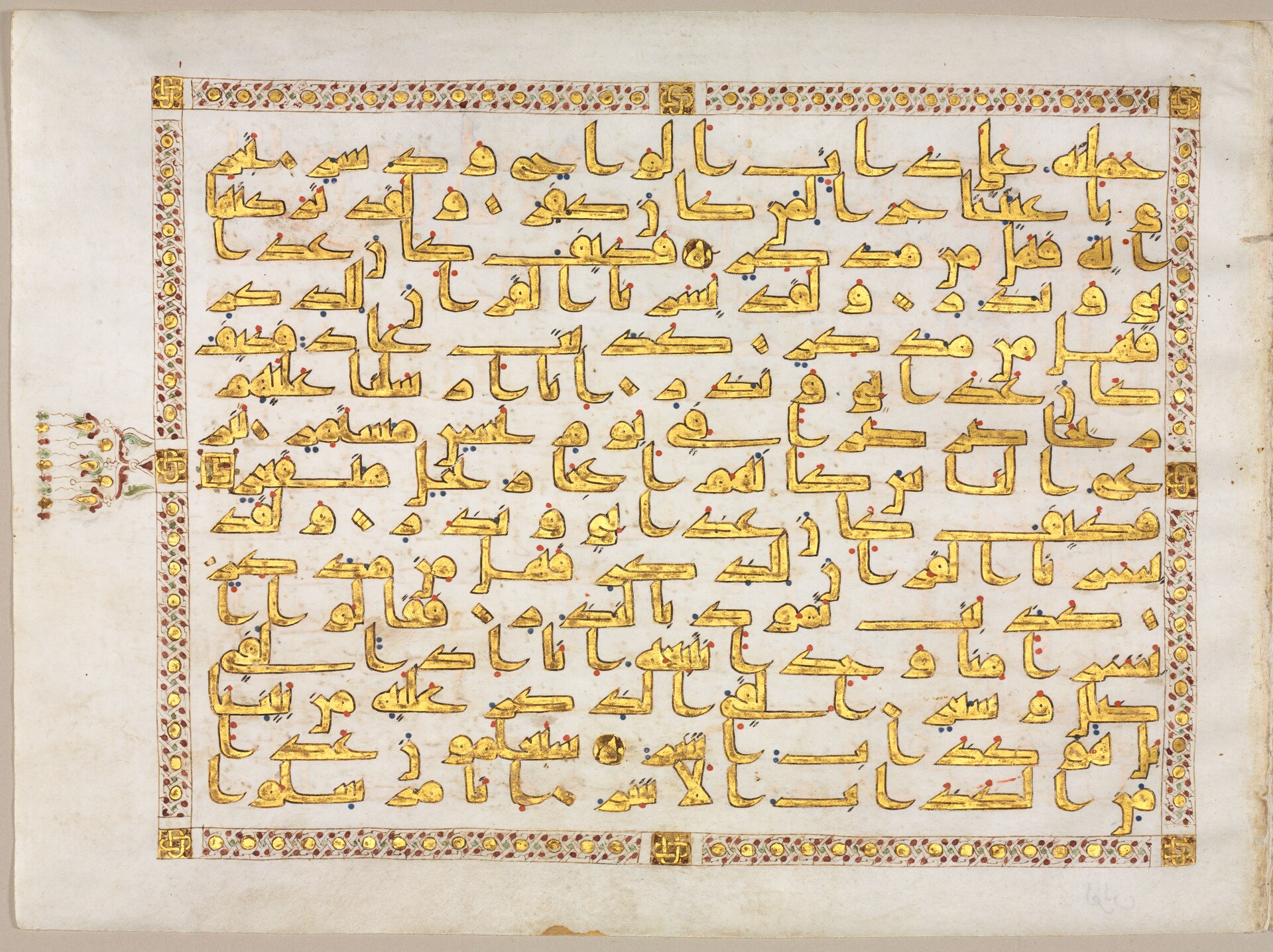
In a cave on Mount Hira around 610 CE, a Meccan merchant given to solitude heard a command: Recite. Muhammad's revelations continued for twenty-three years and became the Quran — for Muslims the literal speech of God, final correction to a prophetic line running back through Jesus and Moses to Abraham. Mecca's establishment answered with persecution; the community's migration to Medina in 622 marks year one of the Muslim calendar, the moment a following became a polity.
Expansion and the caliphates
Within a century of the Prophet's death, Muslim rule reached from Spain to the Indus — one of the fastest expansions in history, carrying a faith that organized law, trade, and learning as one fabric. Under the Abbasids, Baghdad became the world's intellectual capital: Greek philosophy translated and extended, algebra named, medicine systematized. The political unity broke early and never returned, but the civilization held together by scholars, not caliphs.
Sunni and Shia
The community's deepest division is about succession: whether authority passed to elected caliphs (the Sunni position, ~85–90% today) or belonged to the Prophet's family through Ali (the Shia position). Sunni Islam organized itself around four schools of law; Shia Islam around the imams and their scholars. Sufism — the tradition's mystical current — runs through both, seeking the direct experience of God that the law orders from outside.
The five pillars
Practice rests on five pillars: the testimony that there is no god but God and Muhammad is his messenger; five daily prayers facing Mecca; alms at a fixed share of wealth; the Ramadan fast from dawn to dusk; and the hajj pilgrimage once in a lifetime for those able. The Quran is joined by the hadith — collected reports of the Prophet's words and practice — which together ground sharia, the path.
The modern era
Nearly two billion people — a quarter of humanity — are Muslim today, the largest populations in Indonesia, Pakistan, India, and Bangladesh rather than the Arab world. The end of the caliphate in 1924 opened a century-long argument about religion and state that is nowhere near finished, while migration has made Islam the second religion of Europe and the Americas' fastest-growing.
The line
descent is public here — where it came from, what left itBranches:
Sunni Islam — The path of the community's consensus. Shia Islam — Leadership belongs to the Prophet's house. Sufism — The heart can know God directly. Ahmadiyya — The promised renewal has come — a claim the mainstream rejects.