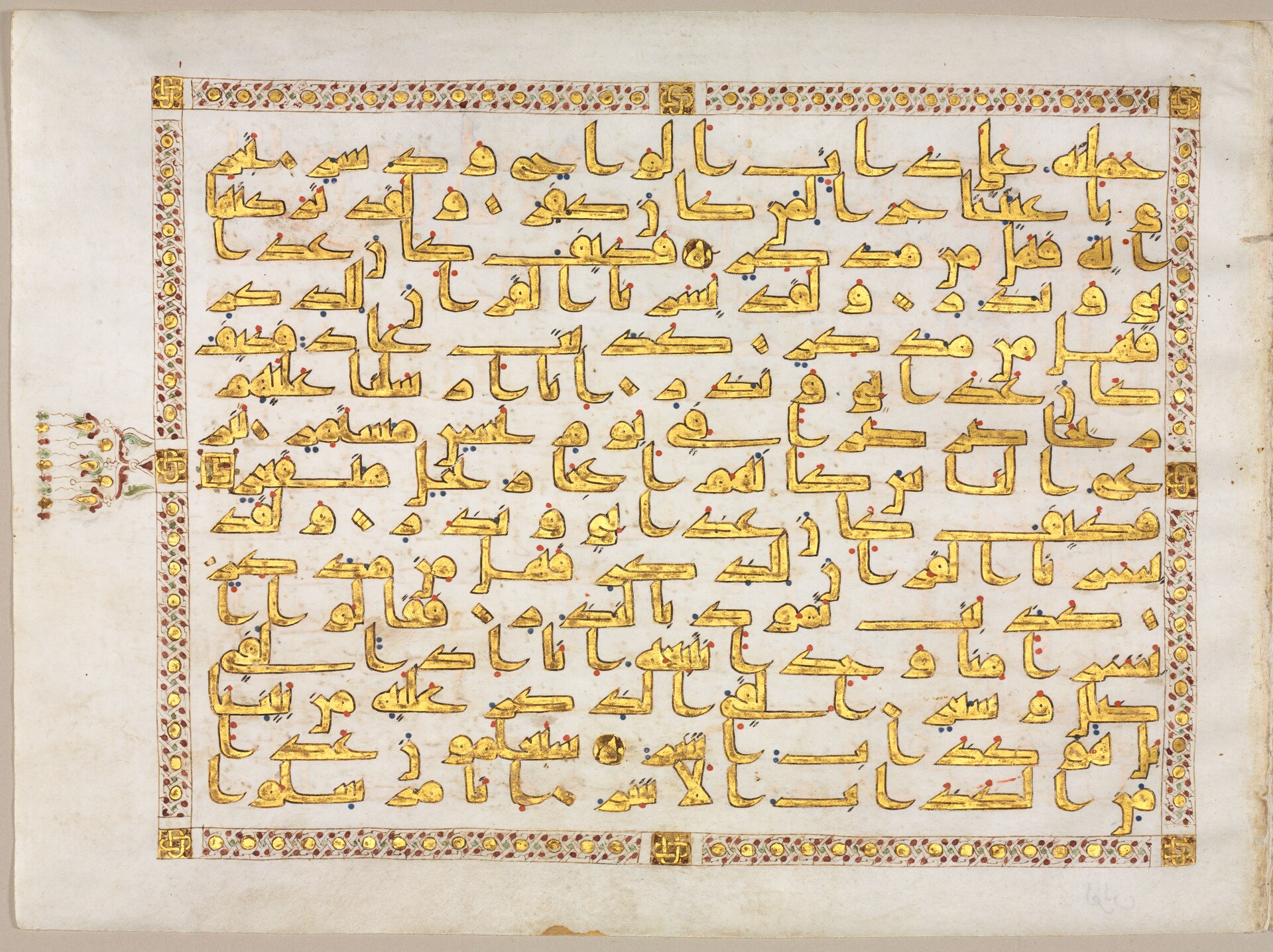
There is no god but God — and life is submission to that fact.
The religion of surrender to the one God, revealed through the Quran to Muhammad, the final prophet in a line reaching back through Jesus and Moses to Abraham. Nearly two billion people order their days around its five pillars.
DeitiesOne, without partner, without image, without son — and the arithmetic is not in dispute anywhere. What is disputed is the etiquette. The unseen is crowded: angels who cannot disobey, jinn who can, a hundred and twenty-four thousand prophets, and — for most Muslims most of the time — the Prophet and the friends of God as people you ask to ask for you. Salafi reformers call that last habit shirk and have demolished shrines to prove it. Shia Muslims address the Imams directly in ziyara texts and are accused of the same. Every Muslim says there is no god but God; the fight is over who else you may talk to.
Founded610 CE · Mecca, Arabia
FounderMuhammad
AfterlifeJudgment, then garden or fire — and mercy outrunning wrath
TextsQuran · Hadith collections
The map
Islam’s corner of it — solid lines are descent; dotted lines are resemblance only, ideas held in common across unrelated faiths. Click a node to recenter; ✕ returns here. All 171 faiths →
610 CE Islam 632 CE Sunni Islam 632 CE Shia Islam 800 CE Sufism 1889 CE Ahmadiyya
Six things are asked of belief.
God, His angels, His books, His messengers, the Last Day, and the decree — the good of it and the bad of it. A stranger walked into the mosque, asked the Prophet to define faith, and got exactly that list. The stranger was Jibril.
Go deeper — context & 1 source →
There is no god but God.
Tawhid: absolute unity — no partners, no images, no exceptions. The first half of the shahada.
Go deeper — context & 1 source →
Nothing resembles Him.
The Quran gives God a hand, a face, a throne. Ash'ari and Maturidi theologians read those as figures of speech and refuse to picture them; the Athari and later Salafi line affirms them as stated and refuses to ask how. Each side accuses the other of the same error from opposite directions.
⚖ contested within
Go deeper — context & 1 source →
Muhammad is the seal of the prophets.
The final messenger in a line that runs back through Jesus and Moses to Abraham.
Go deeper — context & 1 source →
The Quran is the speech of God.
Recited, not authored — revealed in Arabic and preserved as revealed.
Go deeper — context & 1 source →
The book cannot be imitated.
The text dares its critics to produce one sura like it, and the tradition treats the fact that nobody did as the standing miracle. It is close to the only one Islam claims: the Quran declines to give the Prophet the sort of wonders it gives Musa and Isa.
Go deeper — context →
Whether God's speech was ever made.
If the Quran is God's eternal attribute it was never created; if it was created, God once was without it. The Mu'tazila said created, the caliph al-Ma'mun made that state doctrine in 833, and Ibn Hanbal was flogged for refusing to say it. Sunni orthodoxy settled on uncreated. Twelver theology, which kept Mu'tazili rationalism, generally says originated.
⚖ contested within
Go deeper — context →
Life is ordered by submission.
Islam names the act itself: surrender — lived daily through prayer, alms, fasting, and pilgrimage.
Go deeper — context & 1 source →
Every child is born on the fitra.
People arrive already oriented toward God; upbringing turns them elsewhere. The hadith says the parents make the child a Jew, a Christian, or a Zoroastrian — which is why Muslims call conversion to Islam reversion rather than conversion.
Go deeper — context & 1 source →
No inherited sin, and nobody in the doorway.
Adam disobeyed, repented, and was forgiven, and nothing was passed down. There is no fall to be rescued from, no sacrament that must be administered, and no office authorized to stand between a person and God. This is the structural reason Islam has scholars and not priests.
Go deeper — context →
God decreed it, and you will answer for it.
Both halves are asserted, and reconciling them is the oldest fight in Islamic theology. The Ash'ari answer is kasb — God creates the act, the human acquires it. The Mu'tazila and the Twelver Shia rejected that as making God the author of injustice, and hold human acts genuinely free.
⚖ contested within
Go deeper — context →
Every soul stands before God on the Last Day.
Judgment weighs each deed — and, the tradition insists, mercy outruns wrath.
Go deeper — context & 1 source →
The grave is not empty waiting.
Between death and resurrection lies the barzakh, and it opens with two angels, Munkar and Nakir, and three questions: who is your Lord, what is your religion, who is this man. The grave then widens into garden or closes in. Modernist scholars and some Salafis read the scene as figurative; the funeral liturgy does not.
held by most
Go deeper — context →
Someone will speak for you.
On the Day the Prophet intercedes — shafa'a — and most Muslims extend that to prophets, martyrs, the Quran itself, and the friends of God. Salafi scholars accept only intercession requested of God directly, and hold that asking the dead to intercede is precisely what tawhid forbids.
held by most
Go deeper — context →
Mercy outruns wrath.
Every sura but one opens in the name of God the Compassionate, the Merciful — and a hadith holds that His mercy prevails over His anger. Justice is real; mercy is realer.
Go deeper — context & 2 sources →
The law is for something.
Jurists from al-Ghazali to al-Shatibi held that sharia exists to protect five things — religion, life, intellect, lineage, property — and that a ruling which serves none of them has lost its point. The maqasid argument is the main lever of modern reform, and literalists distrust it for exactly that reason.
held by most
Go deeper — context →
Leadership was appointed, not chosen.
Shia Islam holds that God designated Ali, and through him a line of Imams: the imamate is an article of faith, not a political arrangement. Sunni Islam holds that the community chose, and chose rightly. Nearly everything else that separates the two follows from this one disagreement.
⚖ contested within
Go deeper — context →
The People of the Book are not idolaters.
Jews and Christians get a category of their own — their food lawful, their women marriageable, their scripture partly acknowledged, their churches protected. Historically that came bundled with dhimmi status: protection, a poll tax, and legal subordination. What replaces the category inside a modern state is being argued out right now.
Go deeper — context & 1 source →
A
Allah.
The one God — no partner, no likeness, no image. Ninety-nine names describe; none contain.
Meet them — context & 1 source →
T
The angels.
Made of light, incapable of disobedience: Jibril carries revelation, Mika'il provision, Israfil the trumpet. Belief in them is an article of faith.
Meet them — context →
T
The jinn.
Free-willed beings of smokeless fire, living unseen alongside humanity — some believing, some not. Shaytan is of them, not a fallen angel.
Meet them — context →
T
The prophets — one message, many mouths.
Twenty-five are named in the Quran and a hadith puts the total at a hundred and twenty-four thousand, most of them unrecorded. The Quran retells Nuh, Ibrahim, Yusuf, Musa and Isa as Muslims before Islam existed: same message, different peoples, different centuries.
Meet them — context →
The adhan.
Seven lines, five times a day, and in a Muslim-majority city you cannot be outdoors and not hear it. Bilal, an enslaved Ethiopian, was chosen to be the first to call it, which the tradition tells as a deliberate reversal of who gets to speak for a city.
Go deeper — context →
Salat — the five daily prayers.
Dawn, noon, afternoon, sunset, night: the day itself is shaped around remembrance.
Go deeper — context →
Fajr.
Two units, before first light. The tradition treats it as the honest measure of a person's practice because nobody sees you do it and there is no social cost to skipping it — the line in the call to prayer, prayer is better than sleep, is only said at this one.
Go deeper — context →
The Ramadan fast.
No food or drink from first light to sunset for a month — hunger as teacher, iftar as feast.
Go deeper — context & 1 source →
Where next
the museum exit — every door leads deeper inSources
40 cited texts
- Sahih Muslim 8 — the hadith of Jibril (rendered) where it is cited →
- Quran 112 — Surat al-Ikhlas where it is cited →
- Quran 42:11 (rendered) where it is cited →
- Quran 33:40 cited 2× →
- Quran 2:2 where it is cited →
- Quran 3:19 where it is cited →
- Sahih al-Bukhari, Book of Funerals (rendered) where it is cited →
- Quran 99:7–8 where it is cited →
- Hadith qudsi (Bukhari, rendered) where it is cited →
- Quran 7:156 where it is cited →
- Quran 29:46 (rendered) where it is cited →
- Quran 2:183 where it is cited →
- Quran 97:3 (rendered) where it is cited →
- Quran 9:60 (rendered) where it is cited →
- Quran 13:28 where it is cited →
- Quran 3:185 (rendered) where it is cited →
- Quran 96:1–2 where it is cited →
- Quran 19:23 (rendered) where it is cited →
- The farewell sermon (rendered) where it is cited →
- Reported words of Bilal ibn Rabah under torture, in the sira of Ibn Ishaq (rendered) where it is cited →
- Attributed to Rabia al-Adawiyya of Basra, d. 801, transmitted in Attar, Memorial of the Saints (rendered) where it is cited →
- Sahih Muslim 49 (rendered) where it is cited →
- Quran 9:60 where it is cited →
- Quran 2:275 where it is cited →
- Quran 49:12 (rendered) where it is cited →
- Quran 24:30–31 where it is cited →
- Sahih al-Bukhari and Sahih Muslim (rendered) where it is cited →
- Rumi, Mathnawi, opening line, Konya, c. 1258 (rendered) where it is cited →
- Quran 2:255 — the Throne Verse where it is cited →
- Quran 4:125 (rendered) where it is cited →
- Quran 4:157 (rendered) where it is cited →
- Quran 3:42 (rendered) where it is cited →
- Quran 21:107 where it is cited →
- Quran 2:97 where it is cited →
- Hadith (rendered) where it is cited →
- Attributed to al-Husayn at Karbala, in the maqtal literature (rendered) where it is cited →
- Quran 10:62 (rendered) where it is cited →
- Hadith, Sahih al-Bukhari and Sahih Muslim (rendered) where it is cited →
- Hadith, Sunan al-Tirmidhi (rendered) where it is cited →
- Malcolm X, letter from Mecca, April 1964, as published in The Autobiography of Malcolm X where it is cited →
These citations identify texts used in the linked passages. Follow each passage to read its quotation and context. A tradition’s own texts explain its teachings; historical claims may also require independent scholarship. Translations marked (rendered) are our own plain-English wording, not a standard edition; where a passage matters, read it in a full translation.