History & overview · every faith gets one
One God beyond form; all people equal before it.
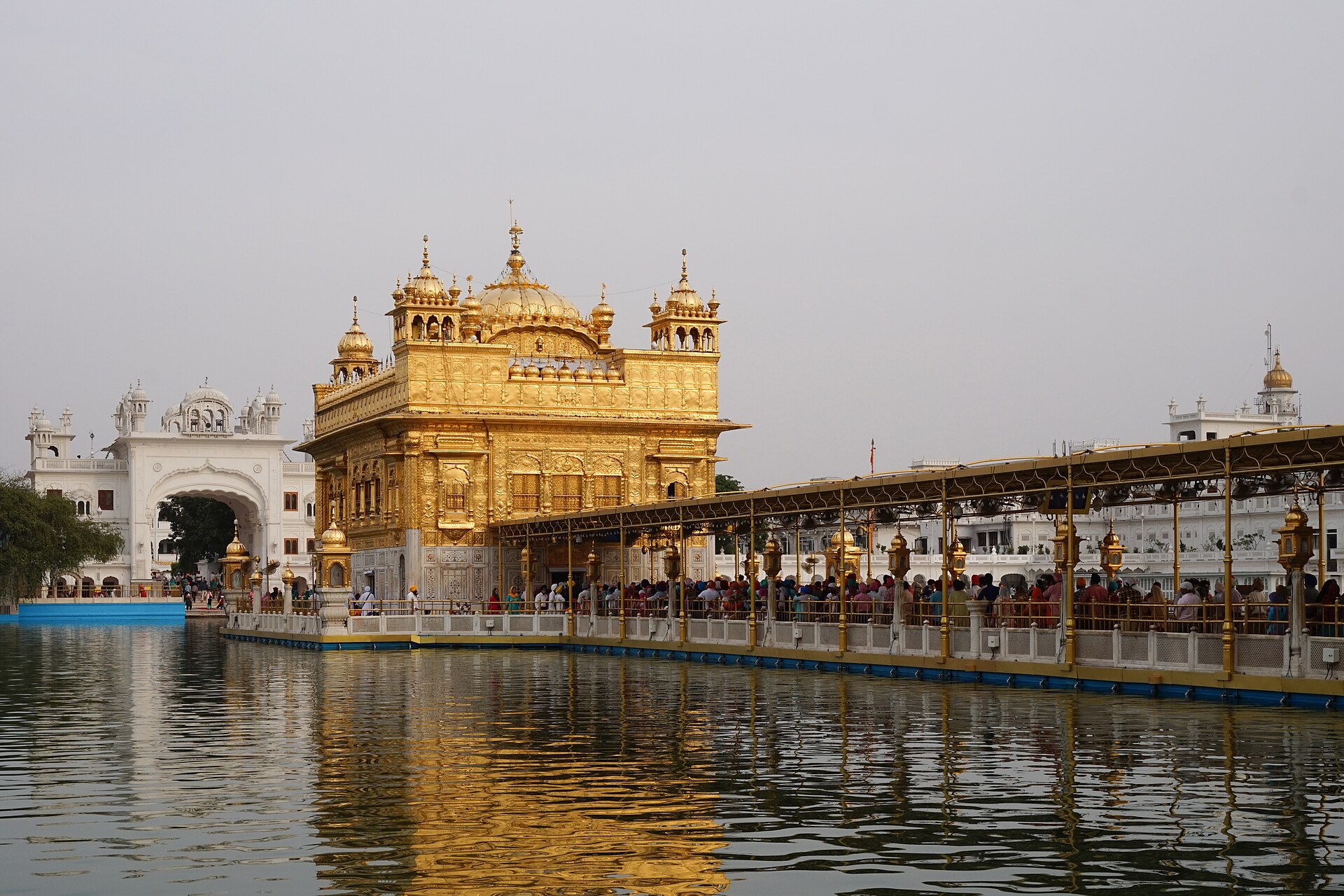
Founded by Guru Nanak in Punjab: one formless God, radical human equality, honest work, and shared bread. The line of ten living Gurus closed with a book — the Guru Granth Sahib — seated as Guru forever.
Nanak and the ten Gurus
Guru Nanak, born 1469 in Punjab, vanished into a river for three days and returned saying: there is no Hindu, there is no Muslim. He walked outward for decades singing one formless God past the boundaries of both traditions, and settled into a community built on remembrance, honest work, and shared bread. Nine Gurus followed him, building institutions — the town of Amritsar, the compilation of scripture — under increasing pressure from the Mughal state, which executed two of them.
The Khalsa and the closed line
In 1699 the tenth Guru, Gobind Singh, founded the Khalsa — an initiated community sworn to visible identity (the five Ks) and the defense of the defenseless. Before his death he closed the line of living Gurus and seated the scripture itself — the Guru Granth Sahib — as Guru forever. Authority in Sikhism has rested in a book and the community's collective judgment ever since; there is no priesthood to inherit it.
Practice
The tradition orders life around three pillars: naam japna, keeping God in remembrance; kirat karo, honest work; vand chakko, sharing what you earn. Its most famous institution is langar — the free kitchen attached to every gurdwara, where anyone of any faith or caste eats the same meal on the same floor. Equality is not an aspiration bolted on; it is the ritual itself.
The modern era
Punjab's partition in 1947 cut the Sikh homeland in half and set off migrations that made the community global; Southall, Vancouver, and California's Central Valley are now fixtures of Sikh geography alongside Amritsar. Roughly 26 million Sikhs make it the world's fifth-largest organized religion — young, visible, and still carrying the founder's refusal of every boundary that sorts people by birth.
The line
descent is public here — where it came from, what left itBranches:
The Ledger of Small Kindnesses — Every kindness is recorded. By you. That is the whole religion.