The ultimate — what this line takes as final
W
Waheguru — the One.
Formless, timeless, beyond gender and image: not worshipped through idols or avatars, but remembered — the Name repeated until it hums beneath ordinary work.
Meet them — context →
Founders & teachers — the ones who opened the way
G
Guru Angad — the alphabet.
Lehna, renamed Angad, my own limb. He standardised the Gurmukhi script, gathered Nanak's hymns into a first collection, and ran a wrestling ground for the village boys alongside the kitchen his wife Khivi kept.
Meet them — context →
G
Guru Amar Das — eat first, then see me.
He made the langar a precondition of audience, so Akbar sat on the floor and ate with everyone before he was received. He forbade sati and purdah among Sikhs, permitted widow remarriage, and put women in charge of some of the twenty-two manjis that taught in his name.
Meet them — context →
G
Guru Ram Das — the city and the wedding song.
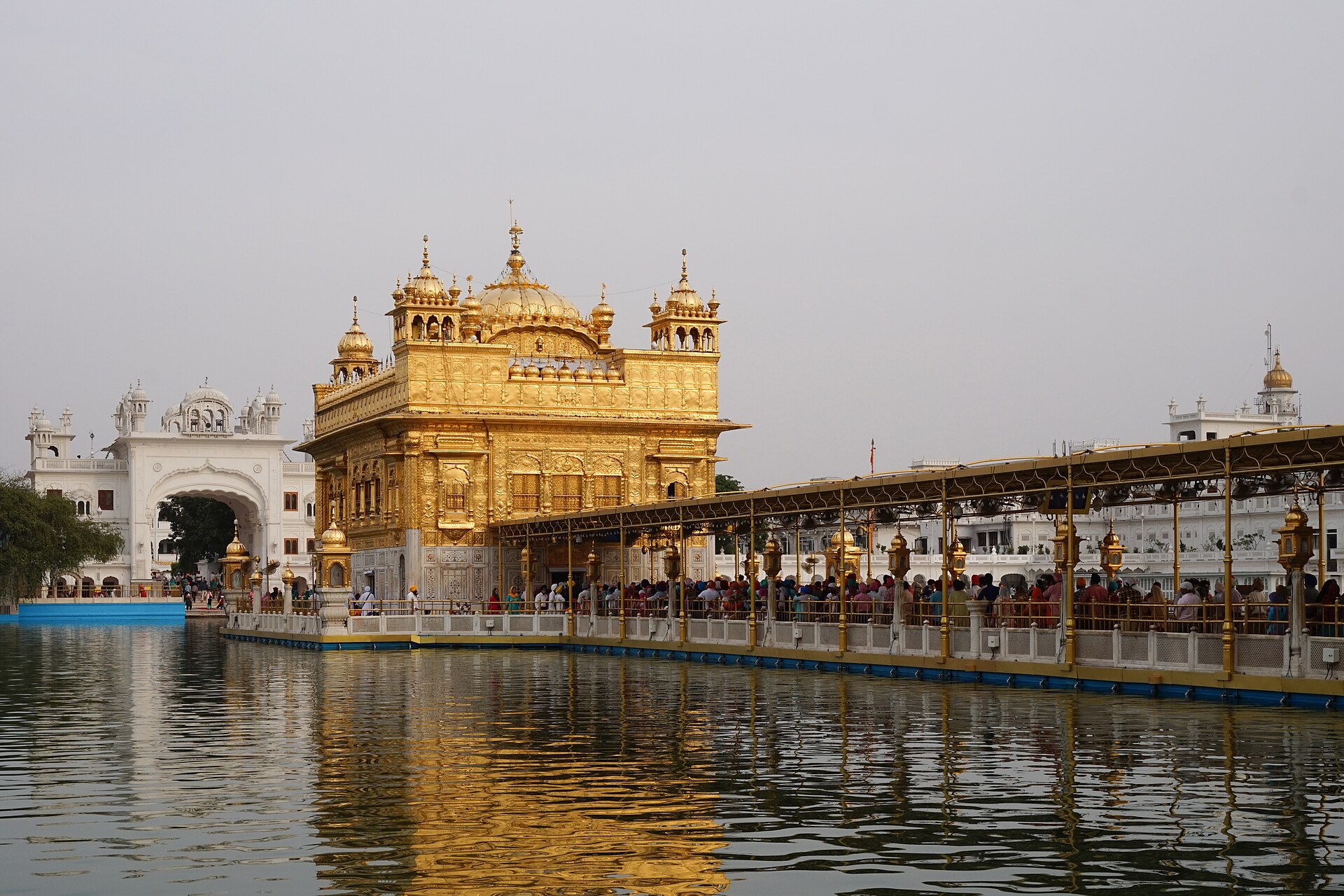
He founded the town that became Amritsar and dug the tank the Golden Temple now stands in. He also wrote the Lavan, so that Sikhs would stop borrowing a marriage rite from the neighbours.
Meet them — context →
G
Guru Nanak — the first light.
Emerged from the river after three days with one sentence — there is no Hindu, there is no Muslim — and walked four directions teaching it.
Meet them — context & 1 source →
G
Guru Hargobind — two swords.
He came to the seat at eleven, days after his father was tortured to death, and wore two swords to the ceremony: miri for worldly authority, piri for spiritual. Then he built the Akal Takht directly opposite the Harmandir Sahib, and the community has been arguing about the relationship between those two buildings ever since.
Meet them — context →
G
Guru Har Rai and Guru Har Krishan — the gardener and the child.
Har Rai kept a herb garden and a free dispensary that treated the emperor's own son, and disowned his elder son for altering a single line of Nanak's verse to flatter Aurangzeb. Har Krishan became Guru at five, nursed Delhi through a smallpox epidemic, and caught it himself at eight.
Meet them — context →
G
Guru Tegh Bahadur — the shield of India.
A delegation of Kashmiri Brahmins facing forced conversion asked him for help; he told them to inform the emperor that if he could be converted, they would follow. He was beheaded in Delhi in 1675 — a martyr for a religion that was not his own, which is why Sikhs call him the cloak of India.
Meet them — context →
G
Guru Arjan — sweet is Your will.
Compiled the scripture, built the Golden Temple, and accepted torture without resistance: the tradition's turn toward steel began with his peace.
Meet them — context & 1 source →
G
Guru Gobind Singh — the last human Guru.
Founded the Khalsa with five who offered their heads, lost four sons, and closed the succession by crowning a book.
Meet them — context & 1 source →
Saints & exemplars — lives held up as the pattern
T
The Panj Piare — five heads, five castes.
At Vaisakhi 1699 five men from five corners of India walked into the tent when the Guru asked for a head: a shopkeeper, a farmer, a water-carrier, a calico-printer and a barber. Then Guru Gobind Singh knelt in front of the men he had just made and asked them to initiate him in turn.
Meet them — context →
B
Bhagat Kabir — the weaver in the scripture.
A Muslim weaver of Banaras who mocked pandits and mullahs with equal appetite and died about fifty years before Nanak was born. Guru Arjan put 541 of his compositions inside the Sikh scripture — more than any Guru except Nanak and Arjan himself.
Meet them — context & 1 source →
B
Bhagat Ravidas — the city with no sorrow.
A leatherworker of the caste that Banaras treated as untouchable, with forty-one hymns in the Guru Granth Sahib. One of them describes Begampura, a city with no tax, no rank and nobody in second place — read in Punjab now as the oldest Dalit utopia in writing.
Meet them — context & 1 source →
S
Sheikh Farid and Bhagat Namdev — the Sufi and the calico-printer.
Farid's couplets, the oldest surviving verse in Punjabi, sit in the scripture as bani; Namdev, a Marathi tailor of the Varkari tradition, has sixty-two compositions. Neither was a Sikh, neither was posthumously converted, and the book carries them as they were.
Meet them — context & 1 source →
B
Bhai Mardana — the Muslim who carried the tune.
A Mirasi bard from Nanak's own village who travelled with him for nearly thirty years, playing the rabab while Nanak sang whatever came. Two of his own verses are in the scripture, and until 1947 the hereditary musicians of the Golden Temple were his Muslim descendants.
Meet them — context →
M
Mata Khivi — the one woman the scripture names.
Guru Angad's wife, who turned the langar from a gesture into an institution that could feed a town every day. Rai Balwand names her on Ang 967 as a good soul who spreads shade like a leafy tree — and no other woman is named anywhere in the book.
Meet them — context & 1 source →
M
Mai Bhago — the woman who turned the deserters back.
Forty Sikhs signed a paper renouncing the Guru and went home to Majha; Bhag Kaur shamed them into riding back, and fought beside them at Khidrana in 1705. She lived, became the Guru's bodyguard, and the forty are remembered as the Chali Mukte — the forty liberated.
Meet them — context →
T
The shaheeds — the martyrs named in the prayer.
Bhai Mati Das sawn in half in Delhi; Bhai Taru Singh's scalp cut away rather than his hair cut; Baba Deep Singh dead at Amritsar at seventy-five. Twice a day the Ardas recalls those who were cut apart limb by limb and scalped and never gave up their faith, which is how a small community keeps a very long memory.
Meet them — context →
M
Mata Gujri and the four Sahibzade.
Ajit Singh and Jujhar Singh died fighting at Chamkaur; Zorawar Singh and Fateh Singh, nine and six, were bricked into a wall at Sirhind for refusing to convert. Their grandmother Mata Gujri, held through December in an open tower, died the same week — and Punjab keeps that week every year in the coldest part of winter.
Meet them — context →
The shared center — held across the tradition
Everything runs under hukam.
The second stanza of Japji states it flatly: everything is inside the command, and nothing is outside it. Hukam is not a sentence handed down but the order the world is already running on — the Sikh task is to read it and stop arguing with it.
Go deeper — context & 1 source →
The world is real, and it is where the work happens.
Nanak kept the vocabulary of maya and refused its usual conclusion: creation is the One at play, not an error to escape. The householder is the model, not the renunciant — Sikhs who left for the forest were sent home to their fields.
Go deeper — context →
God is one, beyond form.
Ik Onkar — the opening word of the scripture and the whole theology in a syllable.
Go deeper — context & 1 source →
Ritual without the heart is theatre.
Asa ki Var takes apart the sacred thread, the ritual bath, the pilgrimage and the fast in turn, and asks what any of them actually changed in the man performing them. The tradition then built rites of its own, and has spent five centuries arguing about which of them went the same way.
Go deeper — context →
Haumai is the disease; the five thieves are the symptoms.
Kaam, krodh, lobh, moh and ahankar — lust, rage, greed, attachment, pride — are described as thieves already living in the house. Haumai, the I-am, is what unlocked the door: nothing external is blamed for the human condition.
Go deeper — context →
All human beings are equal.
Caste is refused outright; the langar seats prince and pauper on the same floor.
Go deeper — context & 1 source →
Countless worlds, and nobody has counted them.
Asked how many earths and heavens there are, Japji refuses the question: there are lakhs upon lakhs, and searching for the limit exhausts the searcher. Punjabi commentators have made a great deal of this since the Hubble images; it was written around 1500.
Go deeper — context →
A human birth is the opening, and it closes.
The soul is said to pass through 8.4 million forms; the human one is the rare chance to remember the Name and get out of the cycle. Karma sets the terms — but the Sikh accent falls on grace, which can cut the sequence short without notice.
Go deeper — context →
Work honestly, and share what you earn.
Kirat karo, vand chhako — labor and generosity as worship.
Go deeper — context & 1 source →
Grace decides. Effort only puts you in its way.
Nadar and kirpa run through the whole scripture: the Name is a gift, never a wage earned by discipline. Discipline is still demanded, on the reasoning that a cup does not make the rain fall but had better be outside when it does.
Go deeper — context →
Liberation happens while you are alive.
Jivan mukti — free while breathing, working and raising children, not after death. Sikh scripture has strikingly little to say about heaven and hell, and treats both mostly as descriptions of a mind.
Go deeper — context →
Remember the Name.
Naam japna — continual remembrance of God, in the kitchen as much as the temple.
Go deeper — context & 1 source →
Woman is not lesser, and the scripture says so in one line.
Why call her bad, from whom kings are born — Nanak, in Asa ki Var. Sikh reformers have been quoting that line back at their own institutions for two hundred years, with uneven results.
Go deeper — context & 1 source →
The sword is legitimate, and it is the last thing you reach for.
The Zafarnama sets the condition in one Persian couplet: when every other means has failed, it is lawful to take up the sword. The tradition treats this as a licence with a lock on it, and argues permanently about who holds the key.
Go deeper — context & 1 source →
The Guru now lives in the book and the body.
Guru Gobind Singh ended the human succession in 1708: authority passed jointly to the Guru Granth Sahib — the scripture as living Guru — and the Guru Panth, the community itself.
Go deeper — context & 1 source →
The Guru's door is open; the Khalsa's door has a threshold.
Anyone may walk into a gurdwara, eat in the langar and sit through kirtan without converting, declaring anything, or being asked their religion. Amrit is a separate act with a written discipline attached, and most Sikhs alive have not taken it.
Go deeper — context →
Held by most — broad, but not universal
Sikhi is its own religion, not a Hindu reform movement.
The Singh Sabha settled this inside the Panth by about 1900; Indian law did not follow. Article 25 of the constitution still files Sikhs under the Hindu heading for personal law, and Sikh bodies have objected in writing since the constituent assembly.
Go deeper — context →
Contested within — affirmed by some schools, refused by others
Whether Sikhs should eat meat.
The Rehat Maryada bans kutha — meat from an animal killed slowly by ritual method — and says nothing whatever about the rest. Damdami Taksal and the Akhand Kirtani Jatha hold to strict vegetarianism and every langar kitchen is meatless, while Nihangs practise jhatka and eat it, and rural Punjab never stopped.
Go deeper — context →
Whether the Dasam Granth is the tenth Guru's.
Three of its compositions — Jaap Sahib, Tav Prasad Savaiye, Benti Chaupai — sit in the daily Nitnem and in the amrit ceremony itself, and nobody disputes those. Whether Guru Gobind Singh wrote the rest, in particular the Charitropakhian, has divided scholars and jathebandis since the nineteenth century and still does.
Go deeper — context →
Cosmos & Afterlife
how reality is built, and what follows deathThe nature of reality
One formless creator, knowable through remembrance
After death
Merge with the One — the cycle of rebirth ended by grace