Community
who belongs, how you join, how it is organized
What makes a gurdwara.
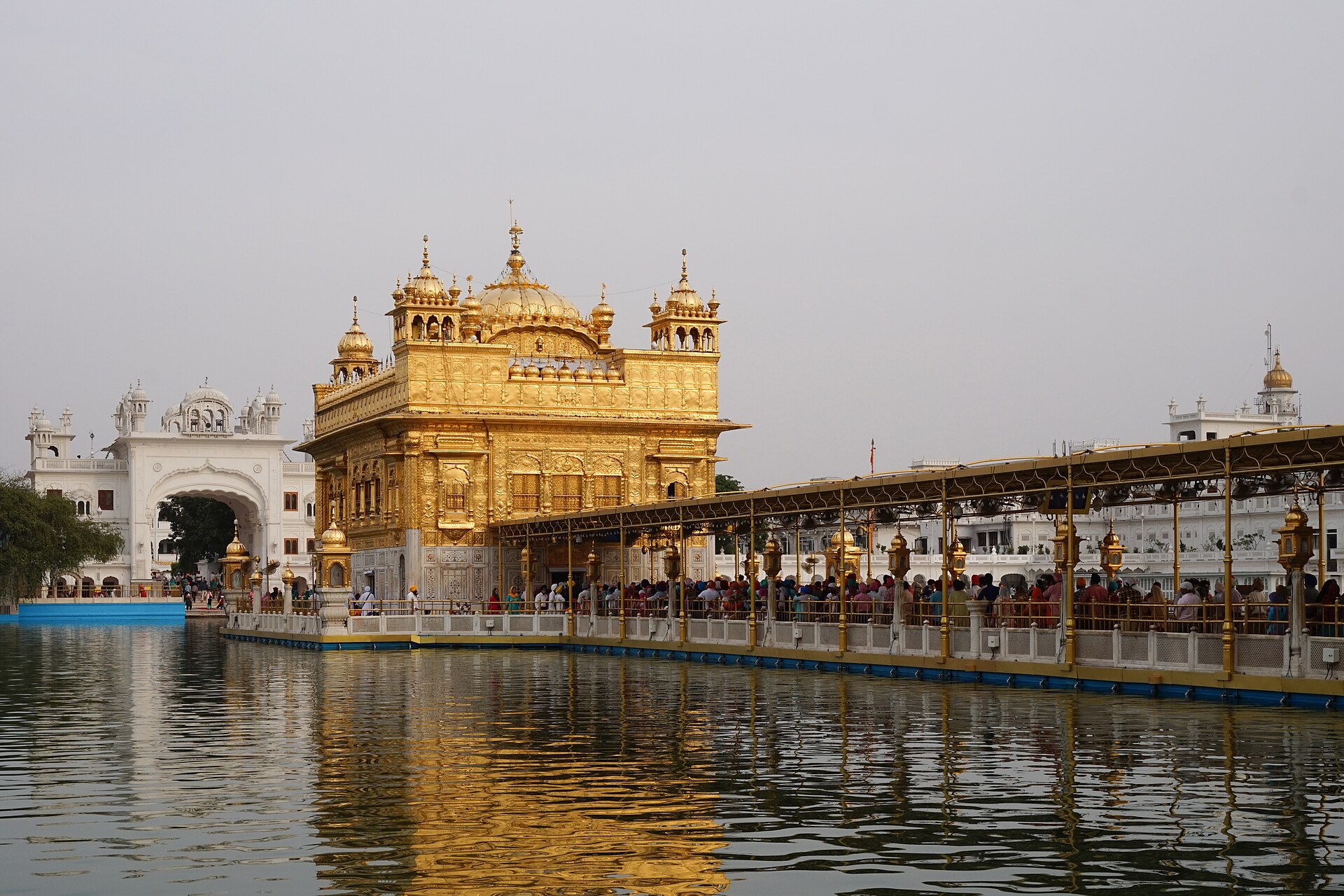
Not the building — a gurdwara is anywhere the Guru Granth Sahib is properly installed, with a triangular saffron Nishan Sahib flying outside and a kitchen running inside. A room above a shop in Southall and the Harmandir Sahib are the same category of thing.
Go deeper — context →
The sangat and the Khalsa.
The congregation is open to everyone; the Khalsa — initiated by amrit — takes the five Ks and the shared names Singh and Kaur.
Go deeper — context →
The Akal Takht and the five Takhts.
Guru Hargobind built the throne of the timeless facing the Golden Temple in 1606, and it remains the seat from which the Panth's collective decisions are pronounced. Four other Takhts share the authority — Kesgarh where the Khalsa was founded, Damdama, Patna where the tenth Guru was born, and Hazur Sahib where he died.
Go deeper — context →
Gurmatta — the Panth decides.
Guru Gobind Singh split his authority: half to the book, half to the community. A gurmatta is a resolution taken by the sangat in the presence of the Guru Granth Sahib, and the doctrine that five Sikhs sitting together carry the Guru's authority is why the tenth Guru obeyed five of his own men at Chamkaur.
Go deeper — context →
The SGPC — who holds the keys.
A statutory body created in 1925 after a five-year non-violent campaign to wrest the historic gurdwaras from hereditary custodians, with an elected house of 190 and control of enormous revenues. It has been dominated by the Shiromani Akali Dal almost throughout, which means the body that appoints the Akal Takht's jathedar is itself a prize in party politics.
Go deeper — context →
There is no priesthood.
A granthi reads and keeps the scripture, ragis sing, a kathavachak explains, and all of them are hired and paid by the local committee. None of them is ordained, none has sacramental powers a shopkeeper lacks, and the Rehat Maryada is explicit that any Sikh may perform any ceremony.
Go deeper — context →
Who pays for it.
The golak box by the door, the daswandh a family gives directly, and kar seva — unpaid labour, including the labour that physically builds and dredges the shrines. Nobody is billed and nothing is means-tested, and the Golden Temple's kitchen alone gets through several tonnes of flour and lentils a day on that basis.
Go deeper — context →
Tankhah — how the Panth disciplines its own.
A Sikh found at fault is summoned, and the sentence is service rather than money: washing dishes, cleaning shoes, reciting for a fixed period, in public. In December 2024 the Akal Takht sentenced Sukhbir Singh Badal, the head of the Akali Dal, to sit at the Golden Temple gate in a sevadar's clothes with a placard listing his offences — and a gunman tried to kill him while he did it.
Go deeper — context & 1 source →
The orders inside the Panth.
Nihangs in blue with towering turbans, keeping their own rehat and their own calendar; Namdharis, who hold that the Guruship continued in human form and are therefore outside the mainstream definition; Nirankaris; the Akhand Kirtani Jatha; Damdami Taksal; the Sevapanthis descended from Bhai Kanhaiya; and the mostly-white 3HO converts of the American diaspora. They disagree about the Dasam Granth, about meat, about who may lead, and about each other.
Go deeper — context →
The diaspora.
Around two million Sikhs live outside India, and the gurdwara is the first thing built — Stockton in 1912, Shepherd's Bush in 1911, a chain of them across British Columbia and the Malayan railways. Diaspora gurdwaras are simultaneously community centres, language schools, welfare offices and proxy battlegrounds for Punjabi politics, and committee elections in Southall or Surrey can be as fought-over as anything in Amritsar.
Go deeper — context →