History & overview · every faith gets one
A path out of suffering, open to anyone, requiring no god.
Founded on the insight of Siddhartha Gautama: existence as ordinarily lived is marked by unease, the unease has a cause, and the cause can be undone. A path of ethics, meditation and wisdom — a departure from the Vedic line that refused its ritual and its gods.
The founder and the awakening
Siddhartha Gautama was born a prince on the Ganges plain around the fifth century BCE, sheltered from the sight of suffering until he met it — sickness, age, death, and a renunciant at peace. He left home, tried austerity to the edge of starvation, and rejected it. Seated beneath a tree at Bodh Gaya he resolved not to rise until he understood; he rose calling himself awake. The four noble truths he taught are a diagnosis: suffering exists, it has a cause, the cause can end, and there is a path.
From sangha to empire
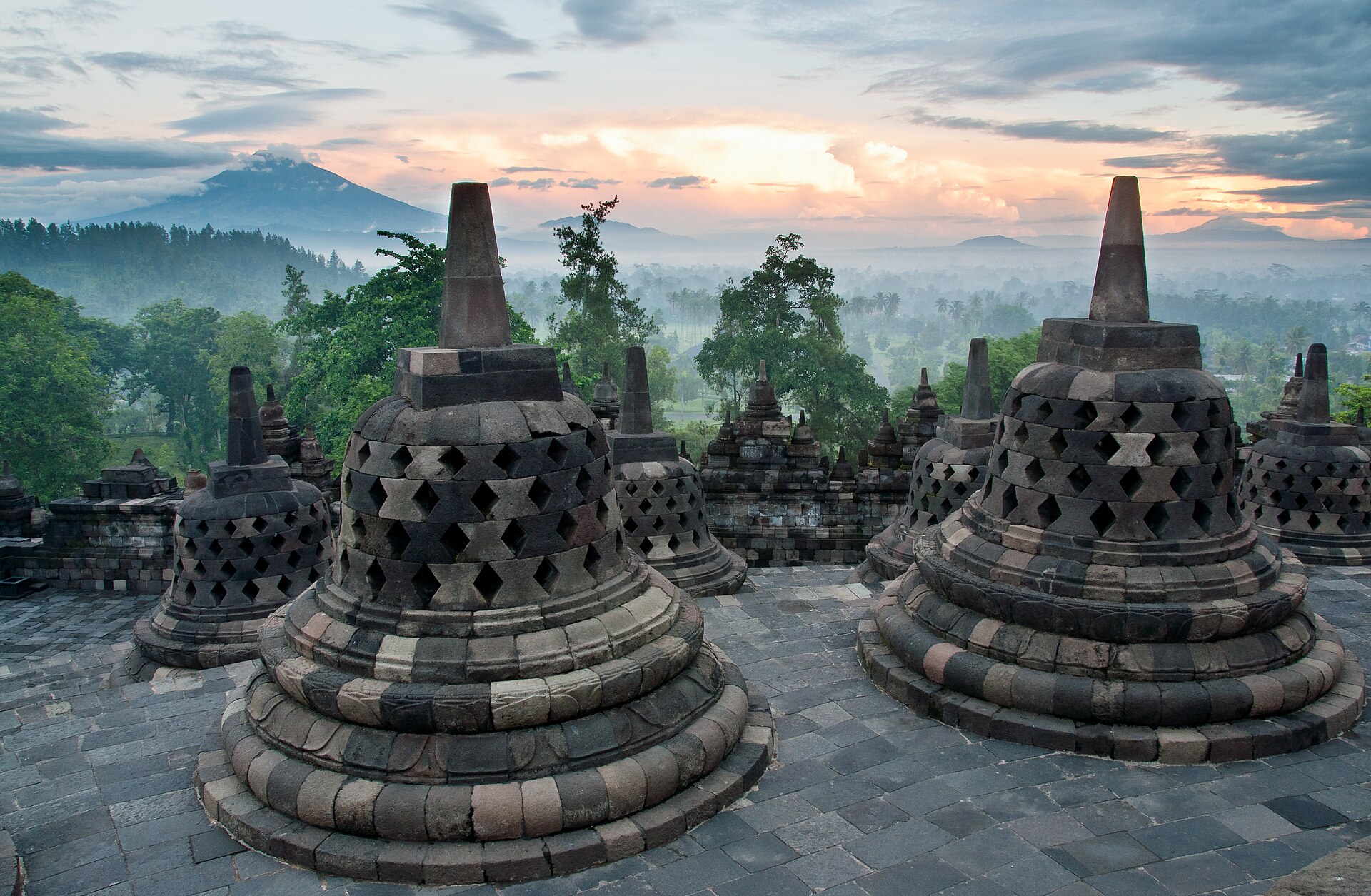
The Buddha organized his followers into the sangha — one of the world's oldest continuous institutions — and taught for forty-five years. Two centuries later the emperor Ashoka, sickened by his own conquests, adopted the teaching and sent missions across Asia. Buddhism travelled the Silk Road into Central Asia and China, south to Sri Lanka and Southeast Asia, and eventually over the Himalaya into Tibet — adapting its forms at every border while carrying the same core.
The three vehicles
Theravāda, the way of the elders, preserves the oldest canon and aims at the arhat's own liberation; it dominates Sri Lanka and Southeast Asia. Mahāyāna, the great vehicle, reframed the ideal around the bodhisattva who defers final liberation until all beings are free; it shaped China, Korea, Japan, and Vietnam — Zen and Pure Land are its children. Vajrayāna, the diamond vehicle of Tibet and Mongolia, added tantric method: ritual, visualization, and the guru's transmission.
Texts and practice
The Pali Canon — three baskets of discourses, discipline, and analysis — is the oldest complete collection; the Mahāyāna added sutras of its own, some the length of libraries. Practice everywhere rests on ethics, meditation, and wisdom: the precepts order conduct, sitting practice trains the mind, and insight is the point of both. Merit-making, pilgrimage, and monastic support carry the lay tradition.
The modern era
Colonialism nearly broke institutional Buddhism in several countries; the twentieth century rebuilt it and exported it. Meditation crossed into Western clinics and boardrooms as "mindfulness," usually stripped of its frame. Around half a billion people practice today, from Theravāda villages to Zen centers in California — and the tradition's old argument about whether any of it requires belief in anything continues, comfortably unresolved.
The line
descent is public here — where it came from, what left itBranches:
Theravāda — The way of the elders — the oldest surviving school. Mahāyāna — The Great Vehicle — awakening, for everyone. Vajrayāna — The diamond path — enlightenment at full speed.