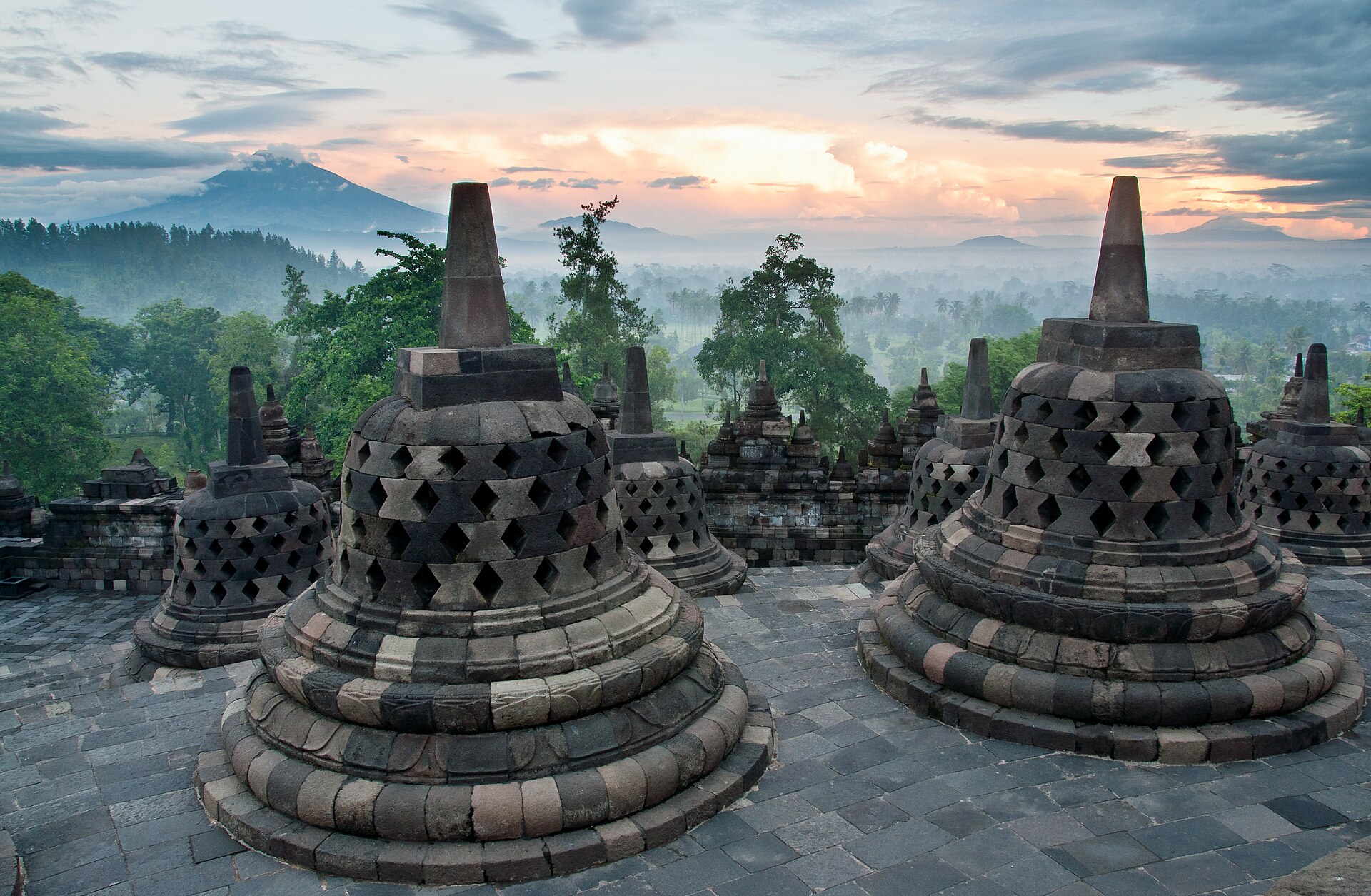
A path out of suffering, open to anyone, requiring no god.
Founded on the insight of Siddhartha Gautama: existence as ordinarily lived is marked by unease, the unease has a cause, and the cause can be undone. A path of ethics, meditation and wisdom — a departure from the Vedic line that refused its ritual and its gods.
DeitiesNo creator — and a crowded cosmos. Gods are real here and beside the point: devas and spirits live longer and better than us and are still dying, still reborn, still unliberated. What is actually prayed to across most of the Buddhist world — buddhas and bodhisattvas — are awakened beings, not gods. The center of the religion holds no one.
Foundedc. 480 BCE · Ganges plain, India
FounderSiddhartha Gautama (the Buddha)
AfterlifeRebirth, until awakening ends it
TextsPali Canon · Mahayana sutras
The map
Buddhism’s corner of it — solid lines are descent; dotted lines are resemblance only, ideas held in common across unrelated faiths. Click a node to recenter; ✕ returns here. All 171 faiths →
c. 1500 BCE Vedic Religion c. 480 BCE Buddhism c. 250 BCE Theravāda 100 CE Mahāyāna 700 CE Vajrayāna
Existence as ordinarily lived is marked by dukkha.
The first noble truth: an unease running through conditioned life — not pessimism, a diagnosis.
Go deeper — context & 1 source →
Suffering has a cause, and therefore an end.
Craving conditions dukkha; the eightfold path is the treatment plan.
Go deeper — context & 2 sources →
Everything that arises passes away.
Anicca, the first of the three marks. Not a mood about mortality: a claim that nothing at all — not the mountain, not the mind watching it — holds still long enough to be a thing.
Go deeper — context & 1 source →
Nothing has a fixed self.
Anatta — persons are processes; clinging to a self is the root error.
Go deeper — context & 2 sources →
A person is five heaps, not a soul.
Form, feeling, perception, formations, consciousness. The tradition takes the self apart on the table and invites you to find the owner among the parts.
Go deeper — context & 1 source →
Liberation is available in this life.
Nirvana is not a place but an extinguishing — the end of the fires of greed, hatred, delusion.
Go deeper — context & 1 source →
No one made this, and no one is running it.
Buddhism has gods and no creator. The universe is beginningless and moves by cause and condition rather than decree — which is why there is no problem of evil here, and no one to appeal to.
Go deeper — context →
Compassion extends to all sentient beings.
Metta and karuna are trained, not merely felt — practices, not moods.
Go deeper — context & 1 source →
Beings are reborn through six realms.
Gods, jealous gods, humans, animals, hungry ghosts, hell-beings — a wheel with no exit but awakening, and human birth the rare rung where the work can actually be done.
held by most
Go deeper — context →
All things arise dependently.
Pratityasamutpada: nothing stands alone — everything arises with conditions and ceases with them.
Go deeper — context & 1 source →
All things are empty of own-being.
Sunyata: emptiness is not nothingness but the absence of independent existence. Nagarjuna pushed it all the way — even emptiness is empty, or it becomes one more thing to hold.
⚖ contested within
Go deeper — context & 1 source →
There are two truths, and both are true.
Conventionally there are chariots, persons and Tuesdays; ultimately none of them has a fixed essence. The error is picking one. The teaching runs on both at once.
held by most
Go deeper — context →
Awakening is uncovered, not acquired.
Buddha-nature: the thing you are trying to reach is already the thing looking. Practice removes rather than adds. East Asia built whole schools on this; the elders decline the premise.
⚖ contested within
Go deeper — context →
The middle way avoids both indulgence and mortification.
The Buddha tried luxury and tried starvation; the path runs between the two failures.
Go deeper — context & 1 source →
The teaching bends to the hearer.
Upaya, skillful means: what gets said depends on who is listening and what will actually free them. It is why the canon contradicts itself, and why the tradition does not read that as a defect.
held by most
Go deeper — context →
Karma is intention.
It is intention, monks, that I call karma — the act begins in the mind, before the hand moves.
Go deeper — context & 1 source →
Merit is real, and it can be given away.
Punya accumulates through giving, restraint and practice — and the ordinary Buddhist act is to make merit and then dedicate it to someone else, usually the dead. The philosophy is upstairs; this is the religion most people live in.
held by most
Go deeper — context →
The teaching is a raft, not a possession.
The Buddha's own image: you build a raft to cross the flood — only a fool carries it on his head afterward. Even the dharma is let go of; clinging to the cure is still clinging.
Go deeper — context & 1 source →
Mind precedes all things.
The Dhammapada opens here: what we are arises from what we have thought. The world you live in is not the world — it is the one your mind has been rehearsing.
Go deeper — context & 1 source →
T
The Buddha.
Not a god and not a savior: a human who woke up, honored as teacher and proof. Offerings express gratitude, not petition.
Meet them — context & 1 source →
A
Amitabha — the buddha of infinite light.
A vow with a loophole in it: call his name in sincerity and be reborn in his pure land, where awakening is easy. The move that made Buddhism available to people with no time to meditate.
Meet them — context & 1 source →
T
The bodhisattvas.
Beings who defer final rest until all are free — Avalokiteshvara's compassion, Manjushri's wisdom: ideals with faces, central in the Mahayana stream.
Meet them — context & 1 source →
K
Ksitigarbha — the one who goes down into hell.
He vowed not to rest while any hell still holds anyone. Patron of the dead, of travellers, and in Japan of children who died before their parents could.
Meet them — context & 1 source →
Puja — the offering at the shrine.
Flowers, incense, a candle and a bowl of water, set out each morning. Nobody is thought to consume them; the flowers are there because they wilt on schedule.
Go deeper — context →
The daily sit.
Attention returned, again, to breath and body — the tradition's laboratory.
Go deeper — context & 1 source →
The nembutsu — saying the name.
Namo Amituofo. Six syllables, repeated, and by Shinran's reading not even yours to repeat — Amitabha is saying them through you. The most-practised Buddhist act on earth.
Go deeper — context & 1 source →
Vesak.
Birth, awakening, and passing of the Buddha honored on one full-moon day.
Go deeper — context →
Where next
the museum exit — every door leads deeper inSources
41 cited texts
- Dhammacakkappavattana Sutta — SN 56.11 cited 2× →
- SN 56.11, the third truth where it is cited →
- Dhammapada 277 (rendered) where it is cited →
- Anattalakkhana Sutta — SN 22.59 where it is cited →
- Milindapañha — the chariot dialogue where it is cited →
- Anattalakkhana Sutta (rendered) where it is cited →
- Mahaparinibbana Sutta — DN 16 where it is cited →
- Karaniya Metta Sutta — Snp 1.8 where it is cited →
- The dependent-arising formula — SN 12 where it is cited →
- Nagarjuna, Mulamadhyamakakarika 24 (rendered) where it is cited →
- SN 56.11 where it is cited →
- Nibbedhika Sutta — AN 6.63 where it is cited →
- Majjhima Nikaya 22 (Alagaddupama Sutta, rendered) where it is cited →
- Dhammapada 1–2 (rendered) where it is cited →
- Satipatthana Sutta — MN 10 where it is cited →
- Shinran, Tannisho (rendered) where it is cited →
- Dhammapada 49 where it is cited →
- The threefold refuge formula where it is cited →
- Mahaparinibbana Sutta (rendered) cited 2× →
- Dogen, Genjokoan (rendered) where it is cited →
- Dhammacakkappavattana Sutta (rendered) cited 2× →
- Therigatha commentary, on Kisa Gotami (rendered) where it is cited →
- The Pancasila, recited in Pali (rendered) where it is cited →
- Shantideva, Bodhicaryavatara 6 (rendered) where it is cited →
- Metta Sutta (rendered) where it is cited →
- Jivaka Sutta (rendered) where it is cited →
- Diamond Sutra, closing verse (rendered) where it is cited →
- Heart Sutra (rendered) where it is cited →
- Huineng's verse, Platform Sutra (rendered) where it is cited →
- Nagarjuna, Mulamadhyamakakarika 13 (rendered) where it is cited →
- Shantideva, Bodhicaryavatara 5 (rendered) where it is cited →
- Dhammapada 276 where it is cited →
- The eighteenth vow, Larger Sukhavativyuha Sutra (rendered) where it is cited →
- The bodhisattva vows (rendered) where it is cited →
- Ksitigarbha's vow, as traditionally rendered where it is cited →
- Attributed across the Mara suttas (rendered) where it is cited →
- Lotus Sutra, ch. 25 (rendered) where it is cited →
- Brahma Sahampati, Ayacana Sutta (rendered) where it is cited →
- Cullavagga X (rendered) cited 2× →
- Itivuttaka 107 (rendered) where it is cited →
- Satipatthana Sutta (rendered) where it is cited →
These citations identify texts used in the linked passages. Follow each passage to read its quotation and context. A tradition’s own texts explain its teachings; historical claims may also require independent scholarship. Translations marked (rendered) are our own plain-English wording, not a standard edition; where a passage matters, read it in a full translation.