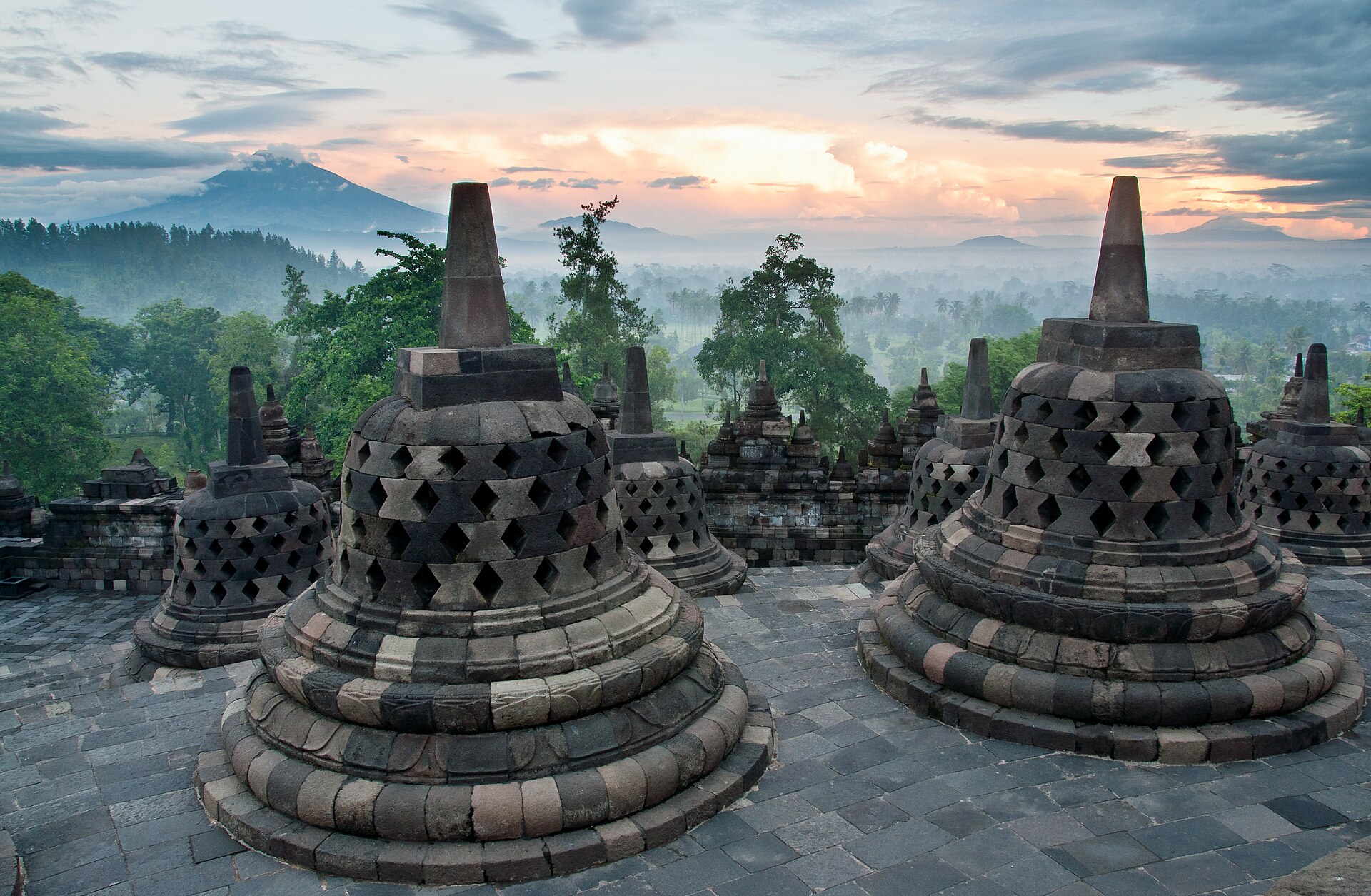
Gods & powers — the presences it names and addresses
A
Amitabha — the buddha of infinite light.
A vow with a loophole in it: call his name in sincerity and be reborn in his pure land, where awakening is easy. The move that made Buddhism available to people with no time to meditate.
Meet them — context & 1 source →
T
The bodhisattvas.
Beings who defer final rest until all are free — Avalokiteshvara's compassion, Manjushri's wisdom: ideals with faces, central in the Mahayana stream.
Meet them — context & 1 source →
K
Ksitigarbha — the one who goes down into hell.
He vowed not to rest while any hell still holds anyone. Patron of the dead, of travellers, and in Japan of children who died before their parents could.
Meet them — context & 1 source →
T
The Medicine Buddha.
Twelve vows, all about healing, made lapis-blue and given a jar. Buddhism admitting out loud that people want their bodies fixed as well as their minds.
Meet them — context →
A
Avalokiteshvara — who hears the cries.
Compassion grown a thousand arms: the bodhisattva who postponed final peace until every being is free, and became Guanyin along the way.
Meet them — context & 1 source →
V
Vairocana — the cosmic buddha.
Not a teacher who lived and died but the dharma with a face: the sun-buddha at the center of the mandala, whom Nara cast in bronze and Shingon made the ground of everything.
Meet them — context →
T
Tara — swift compassion.
The protector called on when there is no time for philosophy: green, already moving, one foot off the lotus.
Meet them — context →
V
Vajrapani — the buddha's strength.
Compassion keeps a bodyguard. Blue, snarling, thunderbolt up: the energy the path needs on the days gentleness will not get it done.
Meet them — context →
M
Manjushri — the sword of insight.
Wisdom as a blade: what it cuts is confusion, and the scripture in his other hand is what remains.
Meet them — context →
M
Maitreya — the one to come.
Buddhism's open future: the next Buddha, waiting — the guarantee that the path never closes behind the last teacher.
Meet them — context →
T
The devas — gods, and beside the point.
Indra and Brahma turn up in the suttas, ask questions, and lose arguments. Buddhism does not deny the gods; it demotes them. They are long-lived, powerful, and still stuck on the wheel.
Meet them — context & 1 source →
Y
Yama — the judge of the dead.
An inherited judge and a whole bureaucracy of hells, plus the insistence that no one is being punished: the realms are karma ripening, and every one of them empties out in the end.
Meet them — context →
T
The dharmapalas — the wrathful protectors.
Skull cups, flayed skins, rings of fire. The guardians of the teaching are terrifying by design, and the terror is aimed at the practitioner's complacency rather than at enemies.
Meet them — context →
Founders & teachers — the ones who opened the way
T
The Buddha.
Not a god and not a savior: a human who woke up, honored as teacher and proof. Offerings express gratitude, not petition.
Meet them — context & 1 source →
P
Padmasambhava — the second buddha.
The tantric master who, the story goes, met the demons of Tibet and put them to work — then hid teachings in rocks and in minds for later centuries to dig out.
Meet them — context →
Saints & exemplars — lives held up as the pattern
T
The great disciples.
Sariputta the analyst, Moggallana the miracle-worker, Ananda who remembered every word, Mahakassapa who held the rule. The teaching survives because a few specific people were in the room.
Meet them — context →
M
Mahapajapati — the first nun.
The Buddha's aunt and foster mother asked to ordain and was refused, three times. She shaved her head, walked barefoot after him with a following, and was admitted — with eight extra rules attached that have been argued over ever since.
Meet them — context & 1 source →
Adversaries — named in order to be refused
M
Mara.
The tempter who tried to talk the Buddha out of awakening — read across the tradition as death, distraction, and the mind's own resistance, personified.
Meet them — context & 1 source →
The shared center — held across the tradition
Existence as ordinarily lived is marked by dukkha.
The first noble truth: an unease running through conditioned life — not pessimism, a diagnosis.
Go deeper — context & 1 source →
Suffering has a cause, and therefore an end.
Craving conditions dukkha; the eightfold path is the treatment plan.
Go deeper — context & 2 sources →
Everything that arises passes away.
Anicca, the first of the three marks. Not a mood about mortality: a claim that nothing at all — not the mountain, not the mind watching it — holds still long enough to be a thing.
Go deeper — context & 1 source →
Nothing has a fixed self.
Anatta — persons are processes; clinging to a self is the root error.
Go deeper — context & 2 sources →
A person is five heaps, not a soul.
Form, feeling, perception, formations, consciousness. The tradition takes the self apart on the table and invites you to find the owner among the parts.
Go deeper — context & 1 source →
Liberation is available in this life.
Nirvana is not a place but an extinguishing — the end of the fires of greed, hatred, delusion.
Go deeper — context & 1 source →
No one made this, and no one is running it.
Buddhism has gods and no creator. The universe is beginningless and moves by cause and condition rather than decree — which is why there is no problem of evil here, and no one to appeal to.
Go deeper — context →
Compassion extends to all sentient beings.
Metta and karuna are trained, not merely felt — practices, not moods.
Go deeper — context & 1 source →
All things arise dependently.
Pratityasamutpada: nothing stands alone — everything arises with conditions and ceases with them.
Go deeper — context & 1 source →
The middle way avoids both indulgence and mortification.
The Buddha tried luxury and tried starvation; the path runs between the two failures.
Go deeper — context & 1 source →
Karma is intention.
It is intention, monks, that I call karma — the act begins in the mind, before the hand moves.
Go deeper — context & 1 source →
The teaching is a raft, not a possession.
The Buddha's own image: you build a raft to cross the flood — only a fool carries it on his head afterward. Even the dharma is let go of; clinging to the cure is still clinging.
Go deeper — context & 1 source →
Mind precedes all things.
The Dhammapada opens here: what we are arises from what we have thought. The world you live in is not the world — it is the one your mind has been rehearsing.
Go deeper — context & 1 source →
Held by most — broad, but not universal
Beings are reborn through six realms.
Gods, jealous gods, humans, animals, hungry ghosts, hell-beings — a wheel with no exit but awakening, and human birth the rare rung where the work can actually be done.
Go deeper — context →
There are two truths, and both are true.
Conventionally there are chariots, persons and Tuesdays; ultimately none of them has a fixed essence. The error is picking one. The teaching runs on both at once.
Go deeper — context →
The teaching bends to the hearer.
Upaya, skillful means: what gets said depends on who is listening and what will actually free them. It is why the canon contradicts itself, and why the tradition does not read that as a defect.
Go deeper — context →
Merit is real, and it can be given away.
Punya accumulates through giving, restraint and practice — and the ordinary Buddhist act is to make merit and then dedicate it to someone else, usually the dead. The philosophy is upstairs; this is the religion most people live in.
Go deeper — context →
Contested within — affirmed by some schools, refused by others
All things are empty of own-being.
Sunyata: emptiness is not nothingness but the absence of independent existence. Nagarjuna pushed it all the way — even emptiness is empty, or it becomes one more thing to hold.
Go deeper — context & 1 source →
Awakening is uncovered, not acquired.
Buddha-nature: the thing you are trying to reach is already the thing looking. Practice removes rather than adds. East Asia built whole schools on this; the elders decline the premise.
Go deeper — context →
Cosmos & Afterlife
how reality is built, and what follows deathThe nature of reality
Conditioned, impermanent, empty of fixed essence — beginningless, and running on cause rather than decree
After death
Rebirth, until awakening ends it