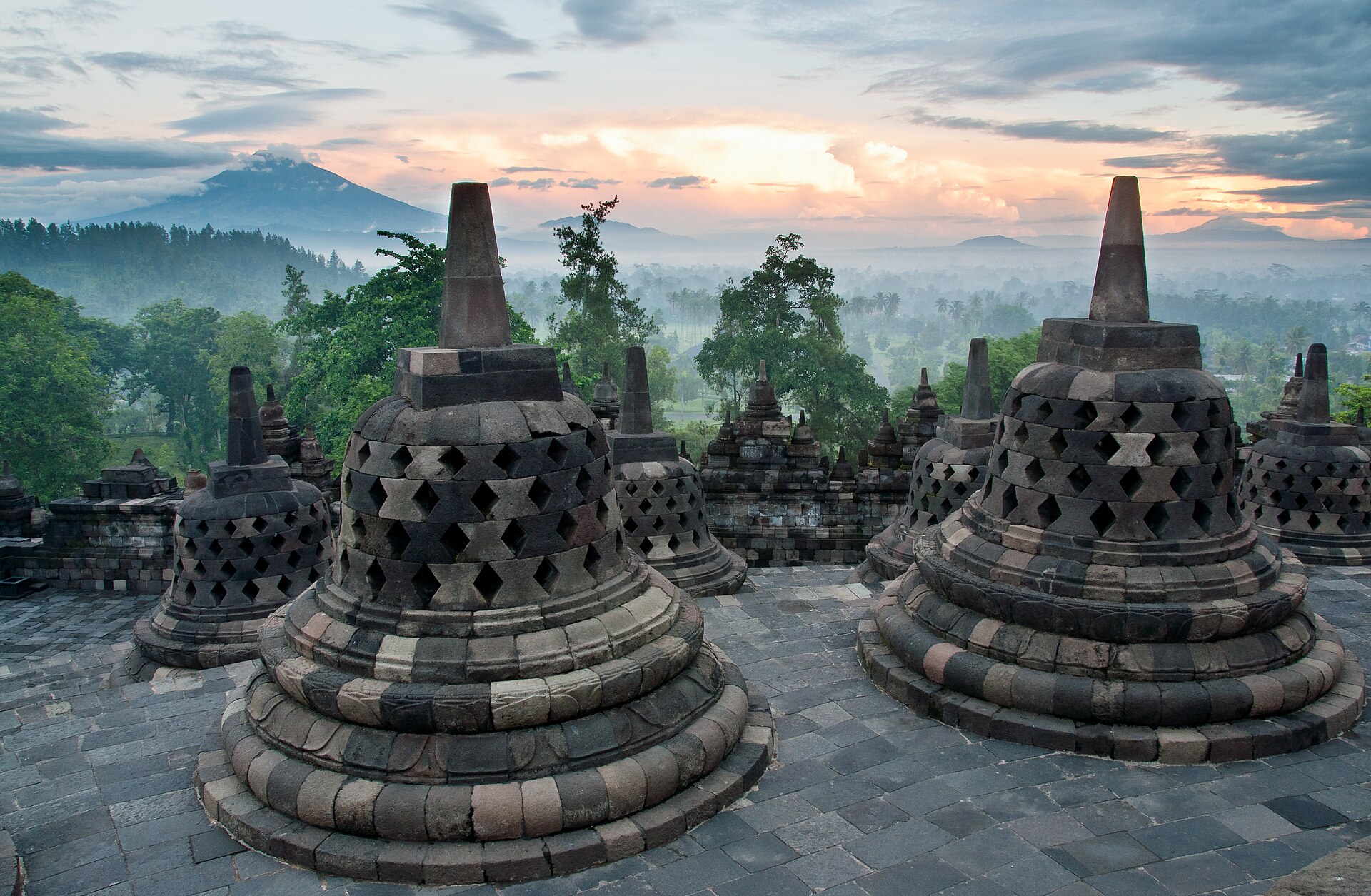
Three vehicles, three worlds.
Theravada in Sri Lanka and Southeast Asia, Mahayana across East Asia, Vajrayana through the Himalaya and Mongolia. They share a founder and diverge on almost everything downstream — and most Buddhists belong to whichever one arrived in their country.
The three vehicles are the most useful first map and a slightly misleading one. Theravada — the way of the elders — holds the Pali Canon, aims at the arhat, and predominates in Sri Lanka, Thailand, Myanmar, Cambodia and Laos. Mahayana adds an open canon, the bodhisattva ideal and emptiness as a universal claim, and covers China, Korea, Japan and Vietnam in forms that differ from each other enormously. Vajrayana, in the Himalaya and Mongolia, is Mahayana plus tantra: the same goal by faster and more dangerous means. The misleading part is that the divisions are geographic accidents of transmission as much as doctrinal choices, and a Thai and a Japanese Buddhist may have less practice in common than either has with a Christian neighbour.
The same ground, other faiths
claims that share this one's ideasSign in to open the first thread. Everything here is attributed.