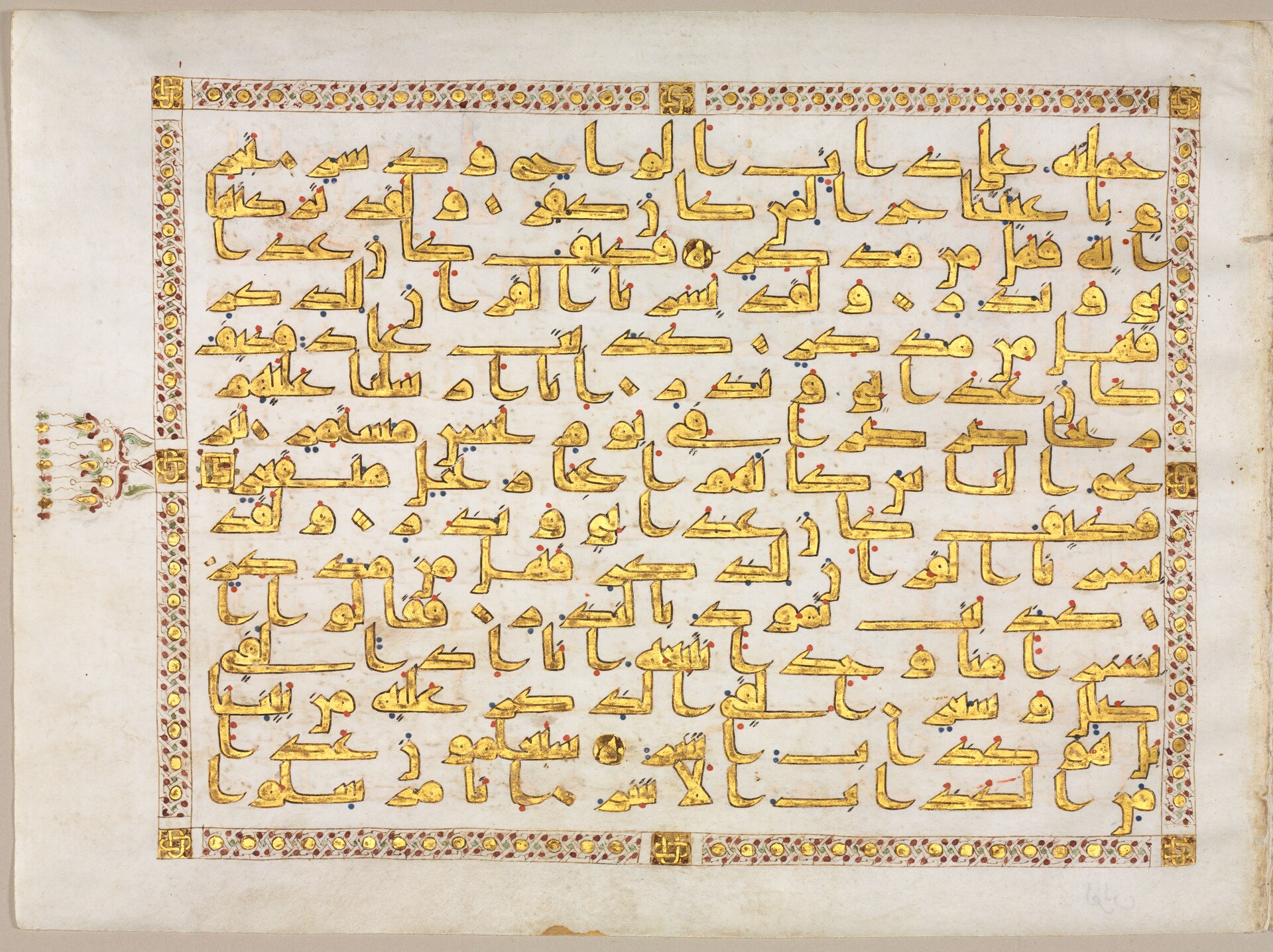
Tajwid, and the ten readings.
The Quran is not read, it is recited, to rules governing vowel length, nasalisation and where the voice may stop. There are ten canonical readings, differing in vowels and occasionally in a word, all considered equally the Quran — a fact that surprises people who expect a single fixed text.
The Quran is a recitation before it is a book — the word itself means recitation — and tajwid is the science of doing it correctly: the length of vowels counted in beats, where nasalisation occurs, which letters merge into the next, and where the voice may stop without breaking the sense. Children in much of the Muslim world learn to recite correctly before they learn what the words mean, which strikes outsiders as odd and is entirely deliberate: the sound is treated as part of the revelation. Beyond tajwid sit the qiraat, the canonical readings. Ibn Mujahid in the tenth century fixed seven as canonical and three more were later added, and they differ in vowelling, occasionally in consonantal detail, and in a handful of places in meaning. All ten are held to be the Quran. The Hafs an Asim reading dominates print and broadcast worldwide; Warsh an Nafi is standard across North and West Africa, so a Moroccan and an Egyptian copy of the Quran do not read identically. International recitation competitions are televised, and champion reciters are national figures.
The same ground, other faiths
claims that share this one's ideasSign in to open the first thread. Everything here is attributed.