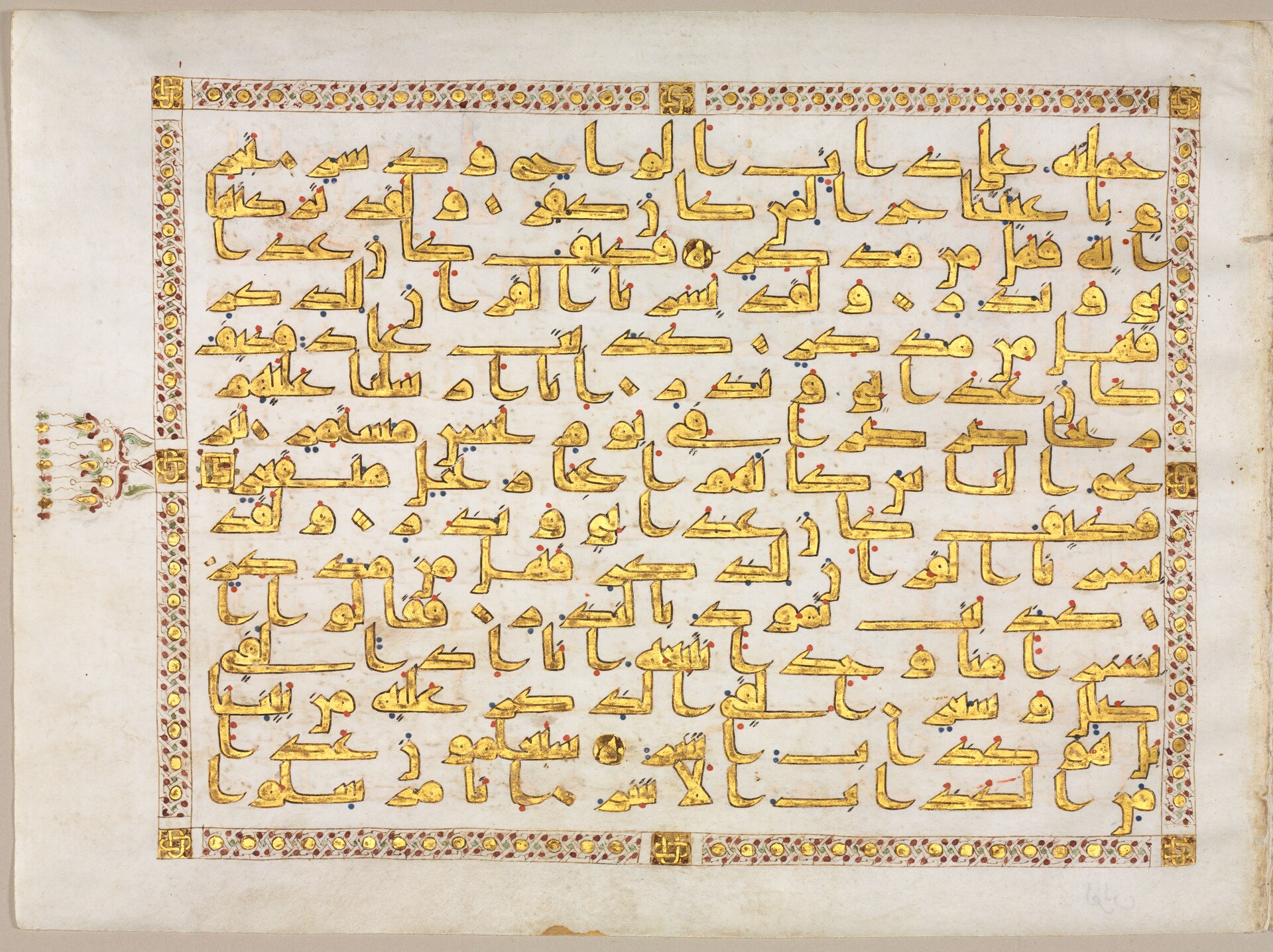
Translation, and the argument about it.
Most of the world's Muslims do not read Arabic, and the tradition holds that the Quran in another language is not the Quran — the standard title is an interpretation of the meanings. So the book people actually read is a rendering with the Arabic beside it, and which rendering carries real theological weight.
The tradition holds that the Quran is the Arabic, and that a translation is an interpretation of the meanings rather than the Quran itself — which is why translations are almost always published with the Arabic facing and titled accordingly, and why ritual prayer is performed in Arabic by Muslims who speak none. Since roughly eighty percent of Muslims are not native Arabic speakers, the book most Muslims actually read is a rendering. The history is contentious: the first Latin translation was commissioned in 1143 by Peter the Venerable for the purpose of refutation, and the first English version in 1649 was similarly hostile. Muslim-produced English translations arrived with Muhammad Ali in 1917, Pickthall in 1930 and Yusuf Ali in 1934, and the field is now crowded — Abdel Haleem, the Saheeh International text that dominates free distribution, Nasr's annotated study Quran, and Laleh Bakhtiar's, which rendered a much-argued verse about striking a wife as going away instead. Which translation a community reads carries real theological weight, and the free global distribution of particular editions has been one of the most effective forms of religious influence in the last half-century.
The same ground, other faiths
claims that share this one's ideasSign in to open the first thread. Everything here is attributed.