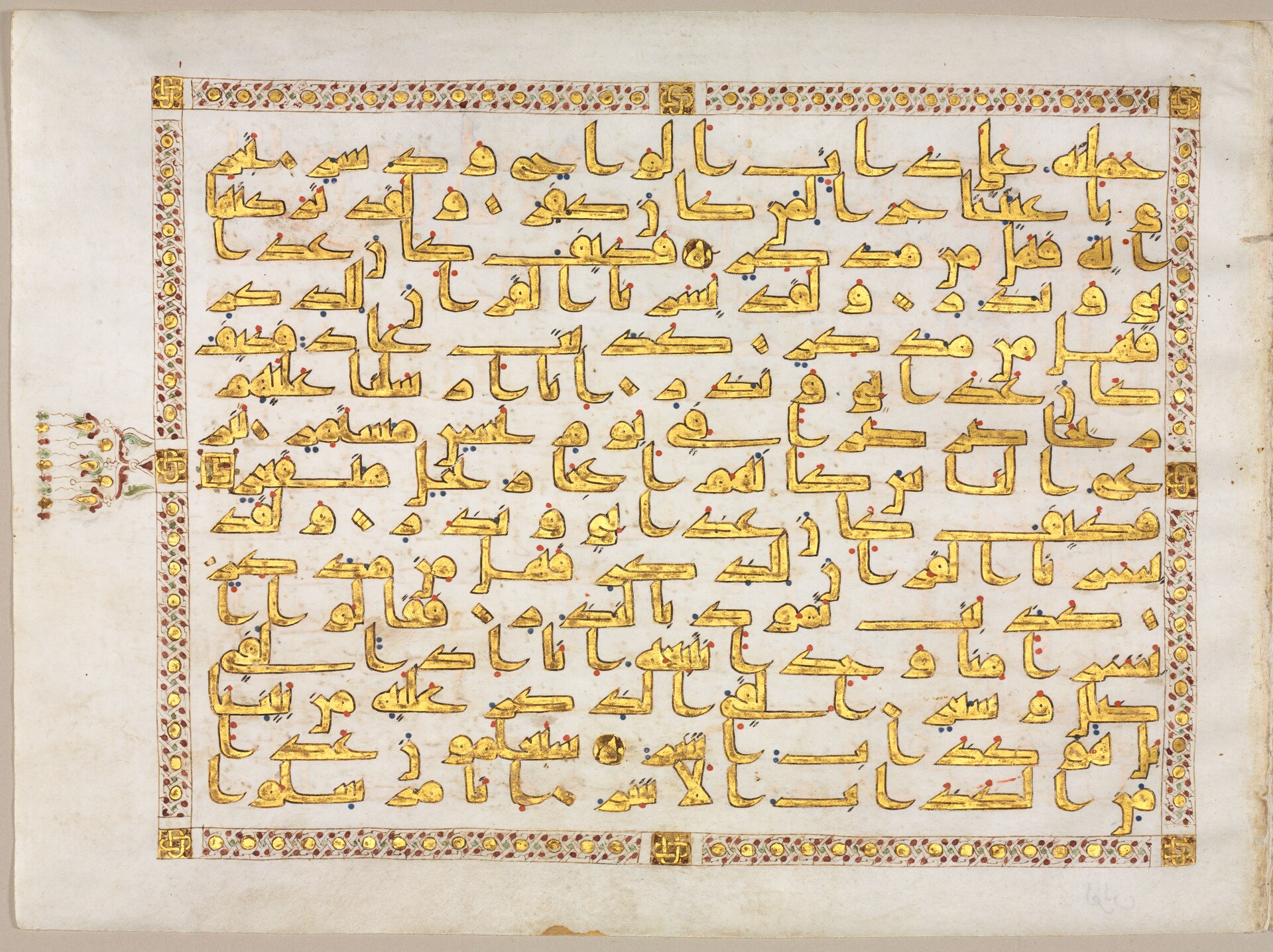
Qur'an folio in gold Kufic, 9th c. · Cleveland Museum of Art · CC0

Islam

Tradition·Founded 610 CE·est. ~2 billion worldwide

Islam → 4 branches

Branch
Story of Islam

The cave of Hira.

A merchant who retreated to a mountain cave to think was seized and commanded: Read. I cannot read, he said. The third time, the words came — and did not stop for twenty-three years.

Where it is toldSura 96 and the sira — Ramadan's anchor
Who appearsMuhammad, Jibril, the cave of Hira
What it teachesRevelation begins with a command to read, pressed on a man who could not
Understanding it — context, not catechism: how this passage is held

The tradition holds that Muhammad was unlettered, which makes the first command — Iqra, read or recite — a demand he could not meet, and the Quran's literary quality is offered as evidence of its source. He came down from the cave terrified, convinced he was possessed, and it was Khadija who steadied him and her cousin Waraqa, a Christian, who identified what had happened. The revelation then paused for a period the tradition remembers as agonizing before resuming, and continued in fragments for twenty-three years.

From the sources — the passages this rests on; concise renderings, cited

Recite in the name of your Lord who created — created man from a clinging clot.

Quran 96:1–2

The first words revealed, in a cave, to a man who could not read.

The same ground, other faiths

claims that share this one's ideas
Scripture is God-breathed. Christianity · core tenet Go deeper →
The Gathas. Zoroastrianism · scripture Open the book →
L L. Ron Hubbard — the Founder. The Church of Scientology · figure Meet them →
D David Berg, who was never seen. The Family International · figure Meet them →
The Rigveda. Vedic Religion · scripture Open the book →
The Vedas & Upanishads. Hinduism · scripture Open the book →

The conversation

argument stays attached to the claim it is about All discussion →

Sign in to open the first thread. Everything here is attributed.

Built on Hatchable