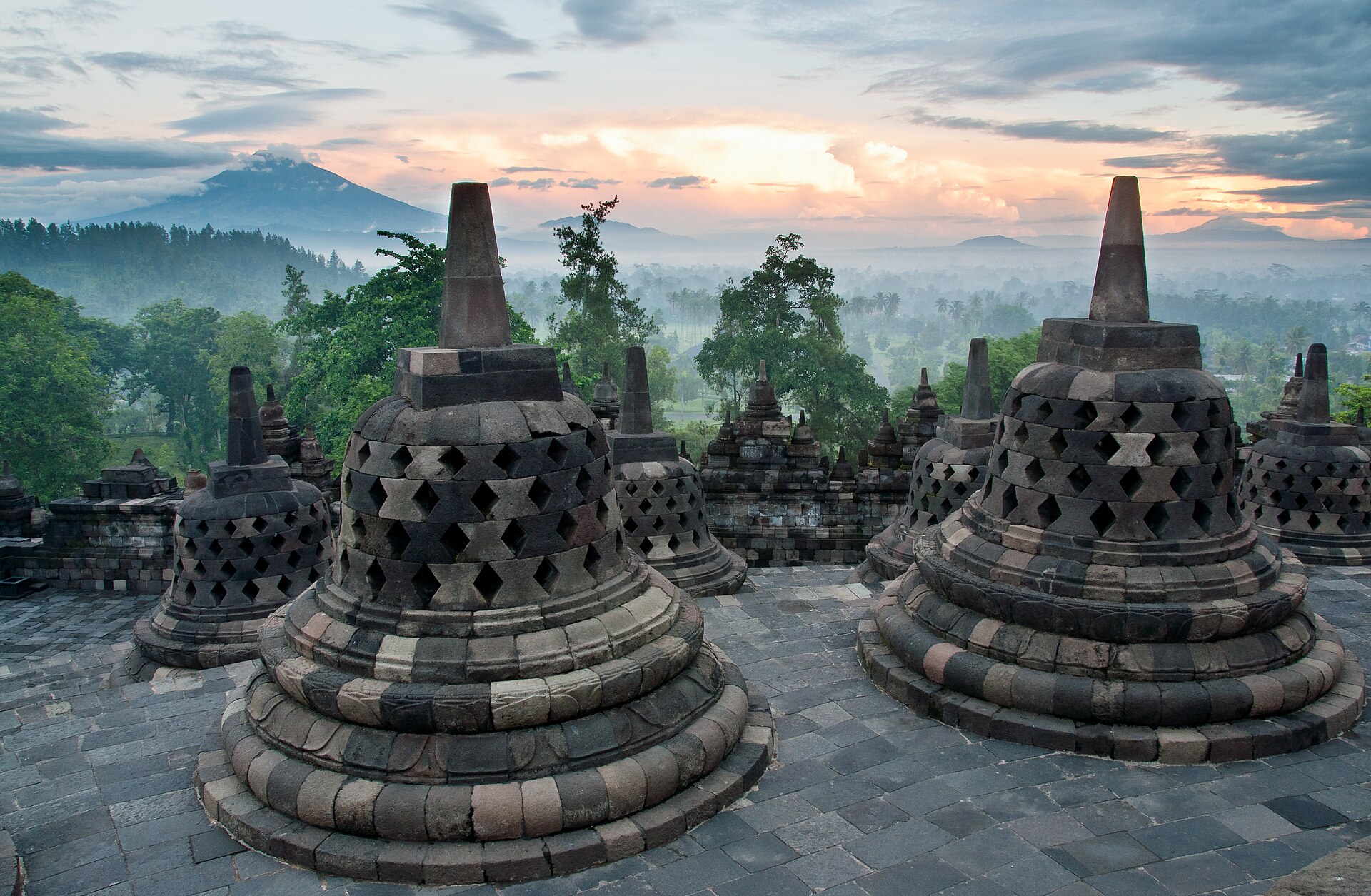
Nirvana — the going out.
The word means extinguishing, as of a flame, and the tradition guards it with negations: not a place, not annihilation, not a heaven, not describable. What ends is the burning.
Go deeper — context →
Jhana — the absorbed mind.
Eight deepening states of concentration, mapped with an engineer's precision: rapture, then stillness, then an equanimity so fine it barely has a name.
Go deeper — context →
Stream-entry, and the three stages after it.
Awakening is graded and irreversible: the stream-enterer has at most seven lives left, and the tradition specifies exactly which fetters have fallen at each stage. It is unusually falsifiable for a mystical claim.
Go deeper — context →
Mindfulness — the ordinary miracle.
Sati: attention that knows what it is attending to. The rare state the practice makes common.
Go deeper — context & 1 source →
Kensho — seeing your nature.
The sudden Zen opening: brief, unmistakable, and by the tradition's own account routinely overrated by the person it happens to. It starts the training rather than finishing it.
Go deeper — context →
Bodhicitta — the mind turned toward others.
The moment concern reorganises around everyone else's liberation rather than your own. Mahayana treats its arising as the single most significant event in a practitioner's life.
Go deeper — context →
The insight knowledges — including the bad ones.
Long meditation practice has a documented rough stretch: dissolution, fear, disgust, and a stage the commentaries frankly name misery. Traditional maps chart it; modern teachers rediscovered it the hard way.
Go deeper — context →
Rigpa — the clear light of mind.
Dzogchen's claim: awareness is already unobscured, and the practice is recognising that rather than constructing anything. Introduced by a teacher directly, and not, traditionally, in writing.
Go deeper — context →
The bardo — the interval.
Forty-nine days between death and rebirth, mapped in detail: lights, sounds and wrathful figures, all of them your own mind, and every one of them an exit if recognised in time.
Go deeper — context →