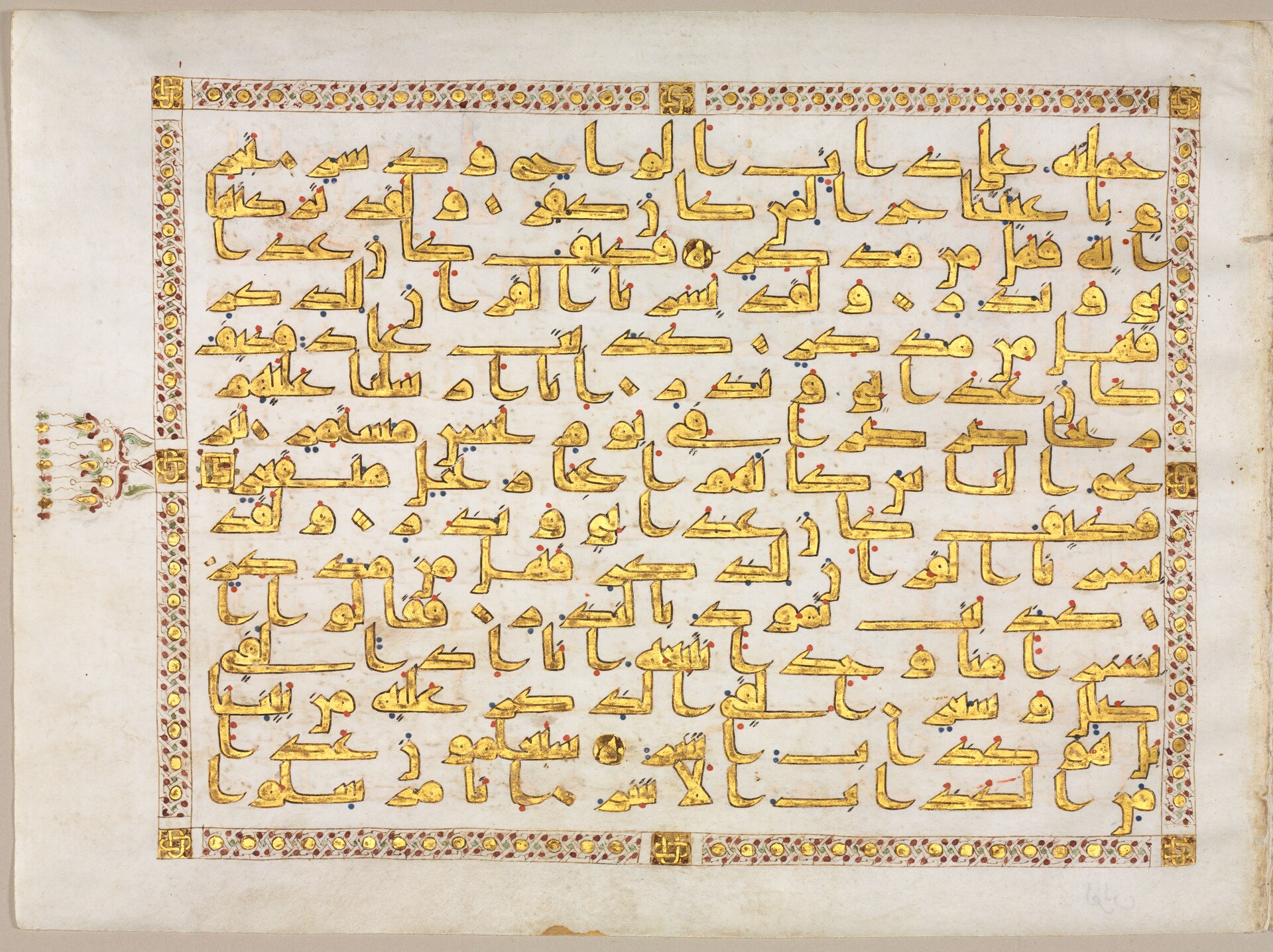
The recitation.
Islam's nearest sacrament is sound: the Quran chanted by the rules of tajwid, where the revelation is not read about but re-sounded.
Go deeper — context →
Khushu.
Attention in the prayer — the point at which it stops being a sequence you are getting through. The tradition treats its absence as the first thing to go and the hardest to get back, and the commentaries on it are mostly practical: slow down, understand the words, do not pray when you need the toilet or the food is served.
Go deeper — context →
Fana.
The sense of being a separate person doing the remembering drops away. The Sufi map puts baqa after it — subsistence, coming back and being able to function. Jurists watch this territory closely, because it is exactly where al-Hallaj said the sentence that got him executed.
⚖ contested within
Go deeper — context →
Tawakkul.
Reliance on God, and the tradition spends most of its energy on the distinction from fatalism. The hadith is blunt about it: a man asks whether he should let his camel loose and trust God, and is told to tie the camel and then trust God. The work comes first; the reliance is about what you do with the part you cannot control.
Go deeper — context & 1 source →
Standing at Arafat.
From noon to sunset on the ninth of Dhu al-Hijja, two million people in identical unsewn white cloth on one plain. The hajj is invalid without it. Malcolm X's 1964 letter from Mecca, describing eating from the same plate as men he would have called white the year before, is the best-known account of what the day does.
held by most
Go deeper — context & 1 source →
Hal and maqam.
A hal is a state that arrives and leaves; a maqam is a station you have actually reached and can stand on. Sufi psychology insists on the difference because confusing the two is the standard way people deceive themselves — a good hour of prayer is not a changed character, and the literature says so repeatedly and unkindly.
⚖ contested within
Go deeper — context →
Sakina.
Stillness sent down. The Quran uses the word for what came upon the Prophet in the cave with Abu Bakr and upon frightened men at Badr, and it shares a root with the Hebrew shekhinah. It is described as arriving rather than being achieved, which is the whole distinction being drawn.
Go deeper — context →