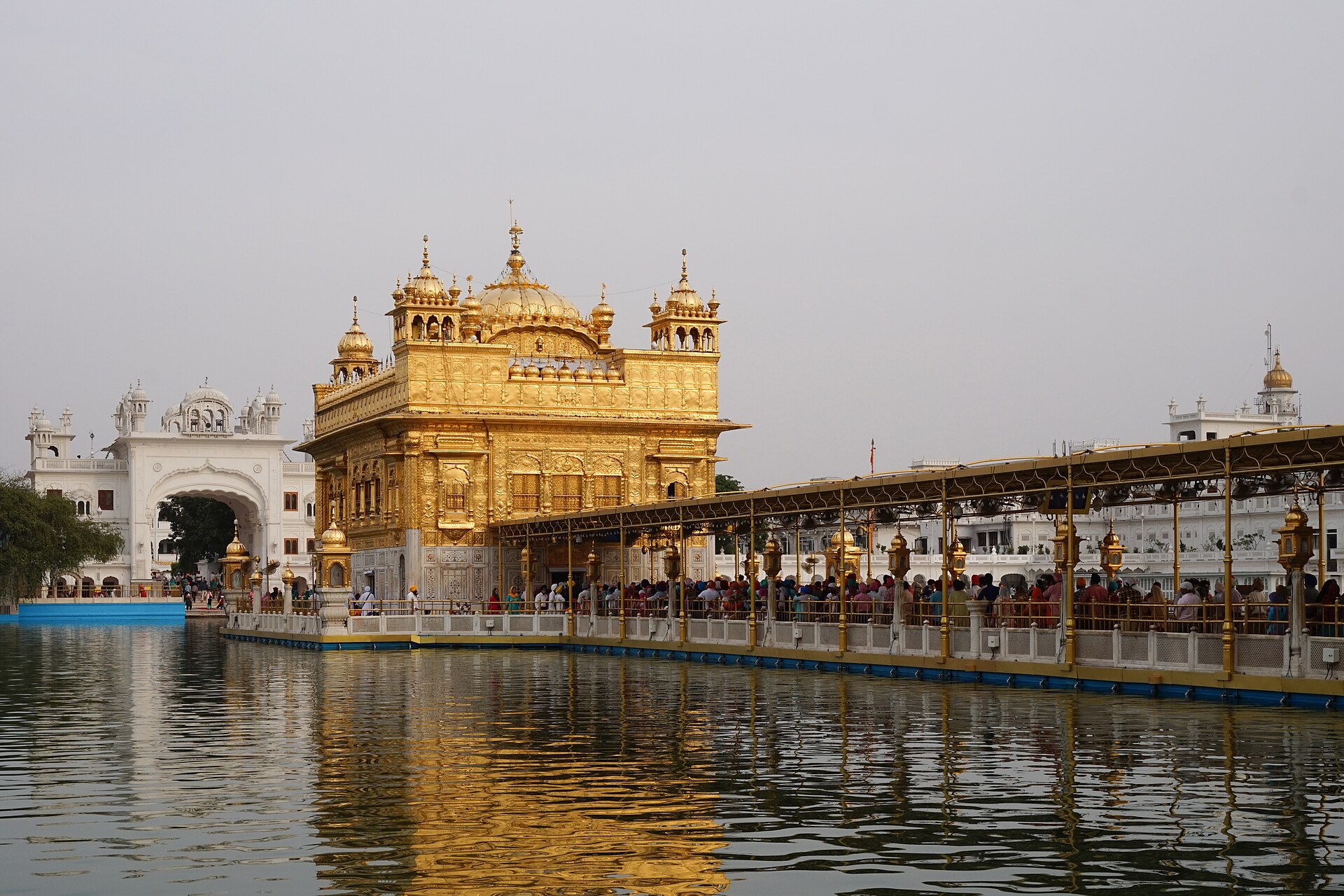
Harmandir Sahib, Amritsar · Bernard Gagnon · CC BY-SA 4.0

Sikhism

Tradition·Founded 1499 CE·est. ~26 million worldwide

Sikhism → 1 branch

Branch
Scripture of Sikhism

The Guru Granth Sahib.

The scripture that is the Guru: the line of ten teachers closed into a book, seated forever.

LanguagePunjabi in Gurmukhi, with Persian and Hindi voices
Composedcompiled 1604; sealed as Guru in 1708
What it holds1,430 pages of hymns — including Hindu and Muslim saints beside the Gurus
How it is usedEnthroned in every gurdwara; read whole in the 48-hour akhand path
Understanding it — context, not catechism: how this passage is held

The Guru Granth Sahib is treated as a living Guru rather than a book about one: it is installed on a raised platform under a canopy, attended with a whisk, put to rest in its own room at night, and transported with ceremony. Its contents are notably plural — alongside the Sikh Gurus it includes hymns by Hindu and Muslim saints, among them Kabir, Namdev, and the Sufi Farid, all preserved as scripture. Guru Arjan compiled it; Guru Gobind Singh sealed it and made it his successor.

From the sources — the passages this rests on; concise renderings, cited

The Granth is the Guru, and the Guru is the Granth.

Attributed to Guru Gobind Singh, 1708 (rendered)

The succession settled on a book rather than a person.

The same ground, other faiths

claims that share this one's ideas
The Rigveda. Vedic Religion Open the book →
The Vedas & Upanishads. Hinduism Open the book →
The Pali Canon. Buddhism Open the book →
The Agamas. Jainism Open the book →
Argument, for the sake of heaven, is sacred. Judaism · core tenet Go deeper →
The Bible. Christianity Open the book →

The conversation

argument stays attached to the claim it is about All discussion →

Sign in to open the first thread. Everything here is attributed.

Built on Hatchable