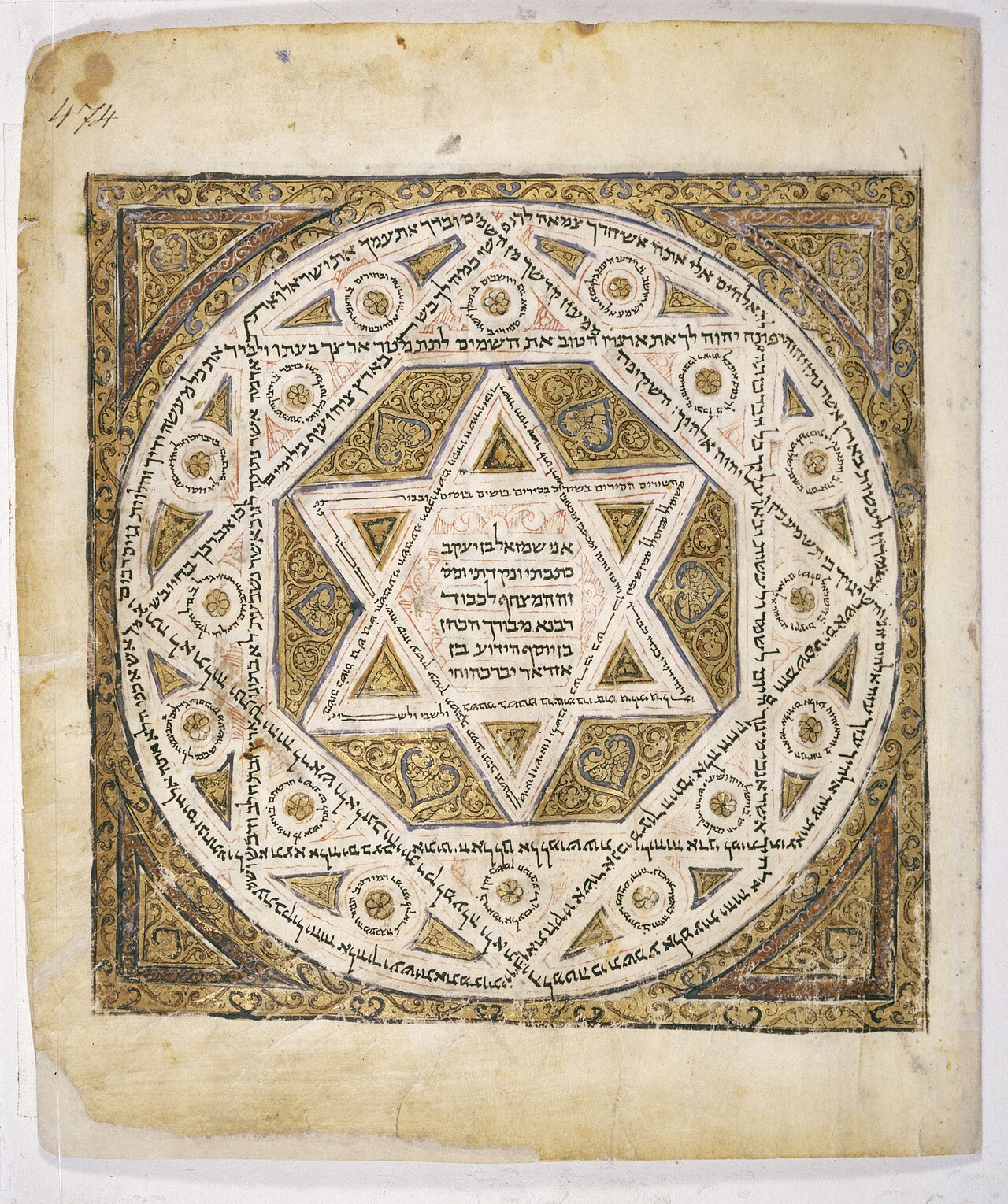
The Mishnah.
It records the opinions that lost, says who held them, and explains why they were kept: so that a later court can revive one. That single decision is the reason Jewish law has a reverse gear.
Open the book — context & 1 source →
The Torah & Tanakh.
Five books of Moses at the core, prophets and writings around them — the library a people carried through every exile.
Open the book — context →
The midrash.
Abraham smashing his father's idols is not in the Bible; it is midrash. The genre works by treating a gap in the text as an invitation rather than a defect.
Open the book — context →
The Talmud.
The oral law written down: Mishnah plus centuries of argument — Judaism's operating system, preserved in debate form.
Open the book — context →
Rashi.
He answers the question a reader is about to ask, and writes I do not know when he does not. His grandsons became the Tosafists who argue with him in the outer margin, so the family disagreement is printed around every page.
Open the book — context →
The Mishneh Torah.
He wrote it without citing a single source, which infuriated everybody, so that an ordinary person could look up the law and stop. Yemenite communities kept a text so accurate that modern critical editions are built on their manuscripts.
Open the book — context →
The Shulchan Aruch.
Karo wrote it as a digest for the young and the busy, and it became the code. Isserles called his glosses the Mapah — the tablecloth over Karo's set table — and the metaphor tells you exactly how much deference was involved.
Open the book — context & 1 source →
The siddur.
What is in it is the sharpest denominational marker after food: which blessings, whether the matriarchs are named, whether the resurrection is literal, whether the prayer for the state is printed. Sephardi and Mizrahi rites carry far more poetry, sung to modes that change with the week's portion.
Open the book — context →
The Zohar.
Its authorship has been disputed since the decade it appeared, by Yemenite and Lithuanian sceptics long before any academic. It is nevertheless the third pillar of Jewish literature by influence, and Lecha Dodi, sung everywhere on Friday night, comes straight out of its world.
Open the book — context →
The responsa.
A question from the Cairo Geniza about whether a woman may divorce a husband who comes home smelling of his trade tells you more about medieval life than any chronicle. The genre is why Jewish law has never needed a legislature.
Open the book — context →
The haggadah.
The Sarajevo Haggadah, made in fourteenth-century Spain, was hidden from the Nazis by a Muslim librarian and hidden again during the siege of Sarajevo. Every ideology has printed its own — kibbutz haggadot with no God in them, feminist ones, Soviet Jewish samizdat ones.
Open the book — context →
The Orit, and the books in Ge'ez.
Beta Israel had no Talmud and no rabbinic literature; the law came from the Orit and from ascetic monastic teachers, with practices that predate or sit outside the rabbinic system entirely. Israel's Chief Rabbinate accepted the community as Jews in 1973 and then asked many of them to undergo a symbolic conversion anyway.
Open the book — context →