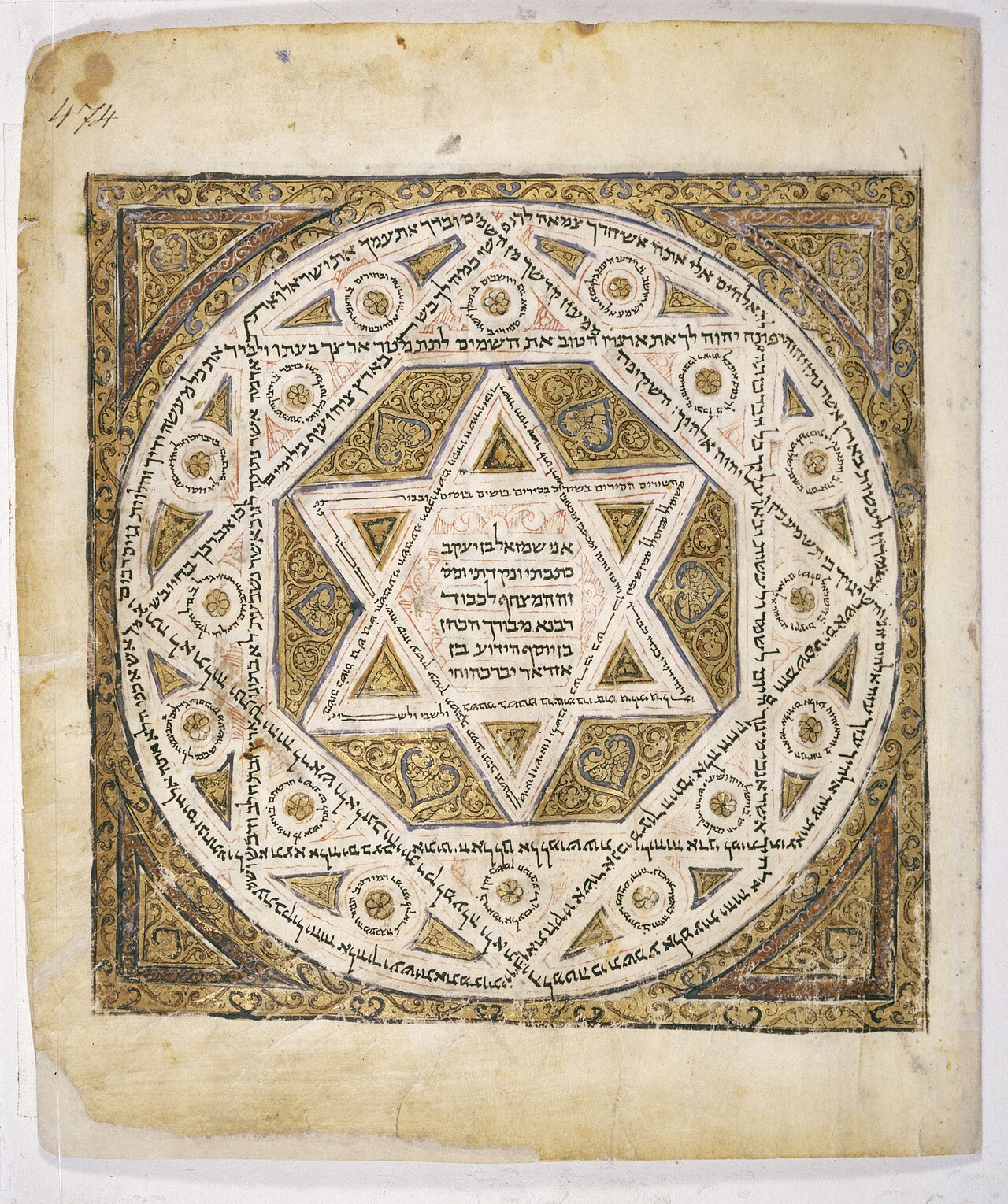
One God, one covenant, one long argument with history.
The covenant faith of the Jewish people: one God who acts in history, a people bound to that God at Sinai, and a law through which the bond is lived. Three millennia of text, exile, return, and argument — argument being a form of devotion here.
DeitiesOne, without body or image, and never approached through anybody else. There is no priest who absolves, no saint who is petitioned, no mediator anywhere in the standard liturgy: on Yom Kippur each person says the confession themselves, aloud, in the plural, to no confessor. The Name written with four letters is not pronounced — Adonai in prayer, HaShem in conversation, and in many printed books a dash instead. Angels appear in the liturgy as a chorus rather than a switchboard, and the medieval poem that asks them to carry prayers upward has been fought over for eight hundred years. Kabbalah maps ten sefirot inside the one God and Hasidism gave the rebbe a role that looks from outside exactly like intercession; both insist, pressed, that the address is still God alone.
Foundedc. 1000 BCE · Ancient Israel
FounderNone — no founding moment
AfterlifeThe world to come — lightly sketched; this life is the arena
TextsTorah · Tanakh · Talmud
The map
Judaism’s corner of it — solid lines are descent; dotted lines are resemblance only, ideas held in common across unrelated faiths. Click a node to recenter; ✕ returns here. All 171 faiths →
c. 1000 BCE Judaism c. 500 BCE Samaritanism 30 CE Christianity 760 CE Karaite Judaism 1740 CE Hasidism 1800 CE Orthodox Judaism
God is one, indivisible, and engaged with history.
The Shema is the center: Hear O Israel — the LORD is one. This God acts in time: exodus, exile, return.
Go deeper — context & 1 source →
God has no body, and no image of God is possible.
Maimonides made incorporeality the third of thirteen principles, and the Torah's outstretched arm became language stooping to be understood. The commandment is enforced hard enough that a tradition three thousand years old produced almost no religious portraiture.
Go deeper — context & 1 source →
A covenant binds a people to God across generations.
At Sinai the bond became mutual and collective — inherited, argued with, never dissolved.
Go deeper — context & 1 source →
Torah came from Sinai.
Torah min haShamayim. Orthodoxy holds the written text was dictated to Moses and the oral law given alongside it; Conservative Judaism reads revelation as real and humanly recorded; Reform reads it as Israel's response to encounter rather than its transcript. This one sentence is the fault line between the movements.
⚖ contested within
Go deeper — context →
The commandments are how the covenant is lived.
613 mitzvot pattern life — how binding halakha remains is the live argument between the movements.
⚖ contested within
Go deeper — context & 1 source →
No one stands between a person and God.
No priest absolves, no saint is petitioned, nobody confesses to anybody. On Yom Kippur each person strikes their own chest through a list of sins written in the plural — everyone says everything, and no human being is listening.
Go deeper — context →
Repairing the world is human work.
Tikkun olam: creation is unfinished, and justice is a duty rather than an aspiration.
held by most
Go deeper — context & 1 source →
A person is built with two inclinations, and neither is a devil.
Yetzer hatov and yetzer hara. The rabbis said that without the evil inclination nobody would build a house, marry, or start a business — so they locked it up, and the hens stopped laying. There is no original sin here and no fallen nature, only an appetite that has to be steered.
Go deeper — context & 1 source →
The messianic age is still ahead.
Whether a person or an era, redemption has not yet come — expectation is part of the faith.
held by most
Go deeper — context & 1 source →
Repentance is always open, and it is work.
Teshuvah is a turn, not a mood. Maimonides sets the test: the same temptation, the same opportunity, and a different choice. Sins against another person God does not forgive at all until that person has been asked — three times, and then the debt passes to whoever is refusing.
Go deeper — context & 1 source →
Every human bears the image of God.
B'tzelem Elohim — the opening chapter's claim with the longest reach: one ancestor, the rabbis taught, so that no one may say my father was greater than yours.
Go deeper — context & 2 sources →
The dead will rise.
Techiyat hametim sits in the second blessing of the Amidah, said standing, three times a day: who revives the dead. Orthodox Jews say it as written. Classical Reform changed the line to who gives life to all, and recent Reform prayer books print both and let the congregation choose.
held by most
Go deeper — context →
Argument, for the sake of heaven, is sacred.
The Talmud preserves the losing opinions. Machloket l'shem shamayim — disagreement pursued honestly — is not a failure of the tradition; it is how the tradition breathes.
Go deeper — context & 1 source →
The Land is part of the covenant.
The liturgy has faced Jerusalem for two thousand years and asks daily for the ingathering of exiles. What follows politically is the most divisive question in Jewish life, and the tradition contains every answer at once.
⚖ contested within
Go deeper — context →
Chosen means obligated.
Asher bachar banu — who chose us — is said before every Torah reading. The rabbinic gloss is consistently about load rather than rank: 613 commandments for Jews, seven for everyone else, and the righteous of all nations have a share in the world to come.
Go deeper — context & 1 source →
There is a world to come, and Judaism will not describe it.
Olam haba is promised constantly and pictured almost never. Gehinnom is capped at twelve months in rabbinic law, which is exactly why a child says kaddish for a parent for eleven — nobody implies their parent needed the full sentence.
held by most
Go deeper — context →
God contracted to make room for the world.
Tzimtzum. Isaac Luria taught in Safed in the 1570s that the Infinite withdrew from a point so that something not-God could exist, and that the vessels made to hold the light shattered. Every commandment kept lifts one fallen spark — which is where the word tikkun comes from.
⚖ contested within
Go deeper — context →
The Shoah broke something, and no answer has held.
Richard Rubenstein concluded that the God of history could not be maintained. Eliezer Berkovits answered with hester panim, the hiding of the face. Emil Fackenheim proposed a 614th commandment — not to hand Hitler a posthumous victory — and the Satmar Rebbe blamed Zionism in print while survivors were still counting their dead.
⚖ contested within
Go deeper — context →
T
The matriarchs — Sarah, Rebecca, Rachel, Leah.
Jeremiah has Rachel weeping for her children and refusing comfort, and God answers her rather than any of the fathers. Whether she is named in the standing prayer is now the fastest way to identify which synagogue you have walked into.
Meet them — context →
H
HaShem — the Name.
The one God, whose four-letter name is not pronounced: creator, covenant-partner, and the only being to whom prayer is directed.
Meet them — context →
M
Miriam — the prophetess with the drum.
The Talmud counts her among seven prophetesses, and links the wilderness water supply to her personally — a very large thing to say about a woman the text gives eleven verses.
Meet them — context & 1 source →
T
The angels — and the rule against asking them for anything.
Malachim are errands rather than persons: one task each, no free will, which is why Judaism never developed patrons. The eight-hundred-year fight over Machnisei Rachamim, a penitential poem asking angels to carry prayers in, is still live — printed in most Ashkenazi selichot and skipped by Jews who follow Maimonides.
Meet them — context →
Three prayers a day.
The weekday Amidah has nineteen blessings and takes about four minutes if you mean it. Most Jews who pray daily do it in a room with other people before work, and the whole thing is over in twenty-five minutes.
Go deeper — context →
Shabbat — the day of rest.
Candles at sundown, work set down, a meal with blessings. A cathedral built out of time rather than stone.
Go deeper — context →
Tefillin and tallit.
Tefillin from the first century BCE were found at Qumran, and the four passages inside are the same four. Ashkenazi and Sephardi Jews disagree about the order of the parchments, and scrupulous Jews put on both sets to cover it.
Go deeper — context →
The Passover Seder.
The Exodus retold at the table with wine, bitter herbs, and questions — every generation instructed to feel it left Egypt itself.
Go deeper — context & 1 source →
Where next
the museum exit — every door leads deeper inSources
44 cited texts
- Deuteronomy 6:4 — the Shema where it is cited →
- Isaiah 40:25 (rendered) where it is cited →
- Exodus 19:5 where it is cited →
- Deuteronomy 30:14 where it is cited →
- Pirkei Avot 2:16 — Rabbi Tarfon where it is cited →
- Bereshit Rabbah 9:7 (rendered) where it is cited →
- Isaiah 2:4 where it is cited →
- Mishnah Yoma 8:9 (rendered) where it is cited →
- Genesis 1:27 where it is cited →
- Mishnah Sanhedrin 4:5 (rendered) where it is cited →
- Talmud, Eruvin 13b where it is cited →
- Tosefta Sanhedrin 13:2 (rendered) where it is cited →
- Passover Haggadah (rendered) where it is cited →
- Deuteronomy 6:4 (rendered) where it is cited →
- Mishnah Yoma 8:9 where it is cited →
- The words of Jewish betrothal (rendered) where it is cited →
- The opening of the mourner's kaddish (rendered) where it is cited →
- Pirkei Avot 5:22 (rendered) where it is cited →
- Exodus 23:9 where it is cited →
- Exodus 24:7 where it is cited →
- Genesis 18:25 (rendered) where it is cited →
- Deuteronomy 30:12, quoted at Bava Metzia 59b where it is cited →
- Ruth 1:16 (rendered) where it is cited →
- Talmud, Shabbat 31a (rendered) where it is cited →
- Talmud, Yoma 9b (rendered) where it is cited →
- Mishnah Peah 1:1 (rendered) where it is cited →
- Mishnah Sanhedrin 4:5 where it is cited →
- Leviticus 19:16 where it is cited →
- Deuteronomy 20:19 (rendered) where it is cited →
- Leviticus 18:5 where it is cited →
- Talmud, Berachot 40a (rendered) where it is cited →
- Mishnah Eduyot 1:5 (rendered) where it is cited →
- Shulchan Aruch, Orach Chayim 1:1 (rendered) where it is cited →
- Exodus 15:20 (rendered) where it is cited →
- Deuteronomy 34:10 where it is cited →
- Genesis 12:1 where it is cited →
- Psalm 51:17 where it is cited →
- 2 Kings 2:11 where it is cited →
- Malachi 3:23 where it is cited →
- Talmud, Sanhedrin 97b (rendered) where it is cited →
- Talmud, Yevamot 47a (rendered) where it is cited →
- Deuteronomy 24:1 (rendered) where it is cited →
- Pirkei Avot 2:13 (rendered) where it is cited →
- Nachman of Breslov, Likutei Moharan II:24 (rendered) where it is cited →
These citations identify texts used in the linked passages. Follow each passage to read its quotation and context. A tradition’s own texts explain its teachings; historical claims may also require independent scholarship. Translations marked (rendered) are our own plain-English wording, not a standard edition; where a passage matters, read it in a full translation.