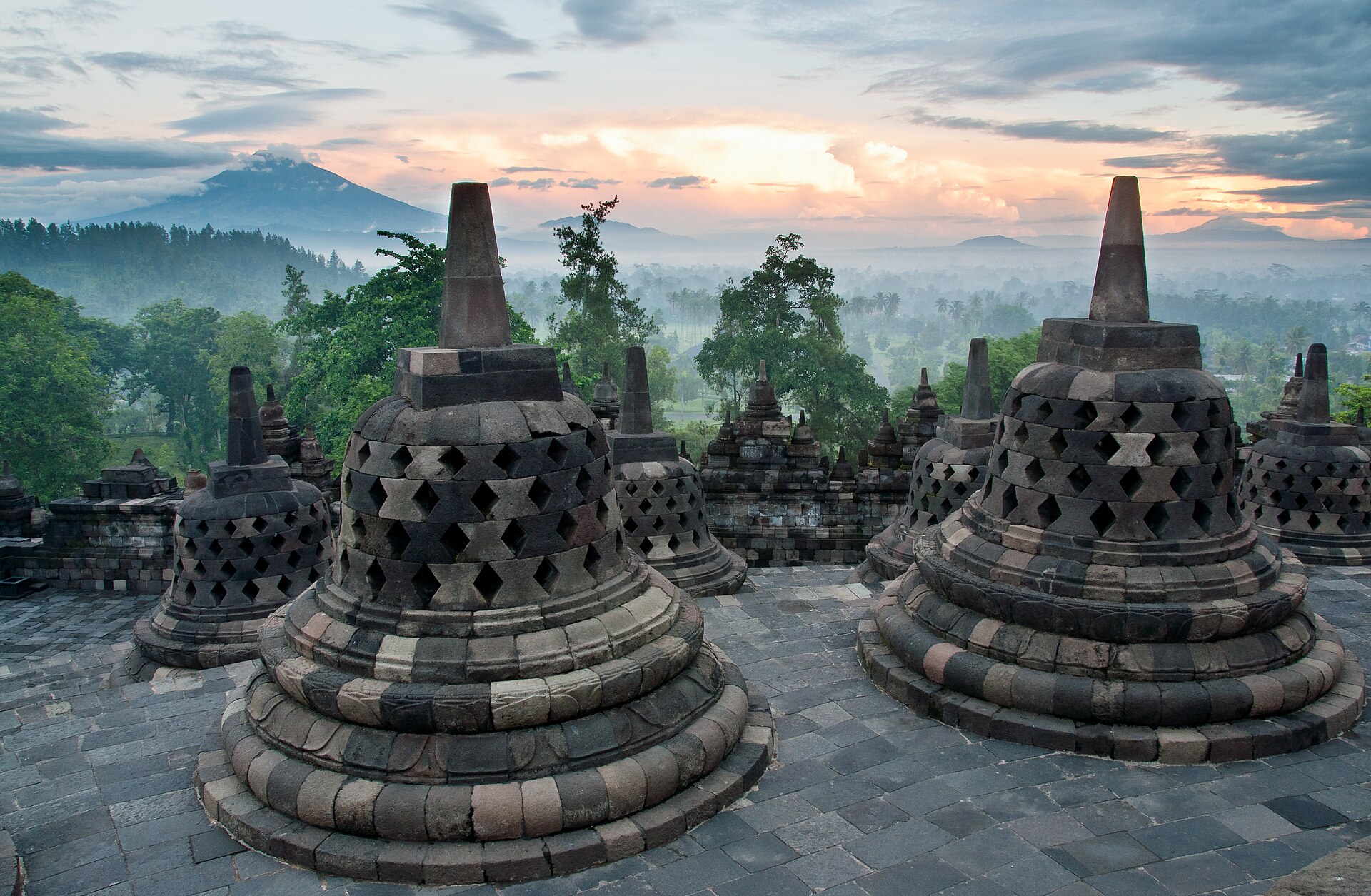
The shared center — held across the tradition
Existence as ordinarily lived is marked by dukkha.
The first noble truth: an unease running through conditioned life — not pessimism, a diagnosis.
Go deeper — context & 1 source →
Suffering has a cause, and therefore an end.
Craving conditions dukkha; the eightfold path is the treatment plan.
Go deeper — context & 2 sources →
Everything that arises passes away.
Anicca, the first of the three marks. Not a mood about mortality: a claim that nothing at all — not the mountain, not the mind watching it — holds still long enough to be a thing.
Go deeper — context & 1 source →
Nothing has a fixed self.
Anatta — persons are processes; clinging to a self is the root error.
Go deeper — context & 2 sources →
A person is five heaps, not a soul.
Form, feeling, perception, formations, consciousness. The tradition takes the self apart on the table and invites you to find the owner among the parts.
Go deeper — context & 1 source →
Liberation is available in this life.
Nirvana is not a place but an extinguishing — the end of the fires of greed, hatred, delusion.
Go deeper — context & 1 source →
No one made this, and no one is running it.
Buddhism has gods and no creator. The universe is beginningless and moves by cause and condition rather than decree — which is why there is no problem of evil here, and no one to appeal to.
Go deeper — context →
Compassion extends to all sentient beings.
Metta and karuna are trained, not merely felt — practices, not moods.
Go deeper — context & 1 source →
All things arise dependently.
Pratityasamutpada: nothing stands alone — everything arises with conditions and ceases with them.
Go deeper — context & 1 source →
The middle way avoids both indulgence and mortification.
The Buddha tried luxury and tried starvation; the path runs between the two failures.
Go deeper — context & 1 source →
Karma is intention.
It is intention, monks, that I call karma — the act begins in the mind, before the hand moves.
Go deeper — context & 1 source →
The teaching is a raft, not a possession.
The Buddha's own image: you build a raft to cross the flood — only a fool carries it on his head afterward. Even the dharma is let go of; clinging to the cure is still clinging.
Go deeper — context & 1 source →
Mind precedes all things.
The Dhammapada opens here: what we are arises from what we have thought. The world you live in is not the world — it is the one your mind has been rehearsing.
Go deeper — context & 1 source →
Held by most — broad, but not universal
Beings are reborn through six realms.
Gods, jealous gods, humans, animals, hungry ghosts, hell-beings — a wheel with no exit but awakening, and human birth the rare rung where the work can actually be done.
Go deeper — context →
There are two truths, and both are true.
Conventionally there are chariots, persons and Tuesdays; ultimately none of them has a fixed essence. The error is picking one. The teaching runs on both at once.
Go deeper — context →
The teaching bends to the hearer.
Upaya, skillful means: what gets said depends on who is listening and what will actually free them. It is why the canon contradicts itself, and why the tradition does not read that as a defect.
Go deeper — context →
Merit is real, and it can be given away.
Punya accumulates through giving, restraint and practice — and the ordinary Buddhist act is to make merit and then dedicate it to someone else, usually the dead. The philosophy is upstairs; this is the religion most people live in.
Go deeper — context →
Contested within — affirmed by some schools, refused by others
All things are empty of own-being.
Sunyata: emptiness is not nothingness but the absence of independent existence. Nagarjuna pushed it all the way — even emptiness is empty, or it becomes one more thing to hold.
Go deeper — context & 1 source →
Awakening is uncovered, not acquired.
Buddha-nature: the thing you are trying to reach is already the thing looking. Practice removes rather than adds. East Asia built whole schools on this; the elders decline the premise.
Go deeper — context →