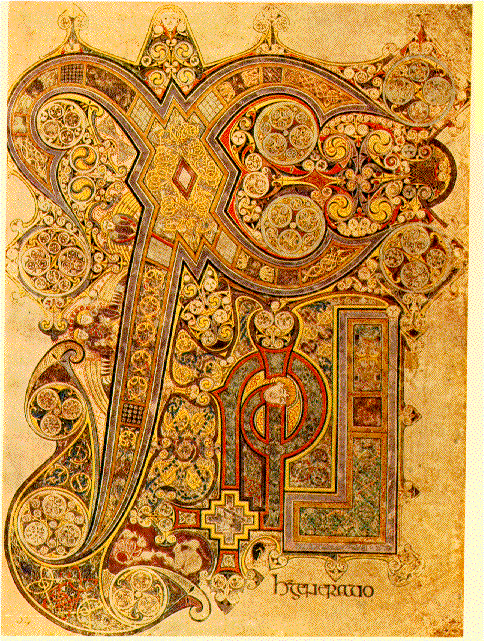
The four gospels — and why four.
Four accounts that disagree in detail were kept side by side instead of being harmonised. Tatian did produce a single merged version around 170 and the church eventually suppressed it. Irenaeus argued for four, no more and no fewer, and gave a reason involving the four winds that convinced nobody and won anyway.
Open the book — context →
The Bible.
Two testaments bound as one claim: the God of Israel kept his promises in Jesus.
Open the book — context →
The letters of Paul.
Occasional letters to specific churches with specific problems, written before anyone wrote a gospel. First Thessalonians, around 50 CE, is the oldest Christian document in existence. Seven are undisputed; the rest are argued about, and the arguments matter, because the harshest lines about women are in the disputed ones.
Open the book — context →
The Nicene Creed.
Hammered out at two councils to settle who Christ is: the rare text Catholicism, Orthodoxy, and most of Protestantism still say together, word for word.
Open the book — context & 1 source →
The Psalms.
The one book the whole church prays rather than reads. Monks recite all 150 on a cycle; Copts pray them by the clock; Ethiopians chant them from the Dawit. They include praise, and they also include a psalm that ends by blessing whoever dashes the enemy's babies against rocks, which the lectionaries quietly skip.
Open the book — context & 1 source →
The translations, and what they cost.
Christianity is the only major religion with no sacred original language, and the consequence is that its scripture has always been in translation. Jerome spent twenty years on the Latin. Tyndale was strangled and burned for the English. Some part of the book now exists in more than 3,700 languages.
Open the book — context & 1 source →
The books that vary.
There is no single Christian Bible. Protestants carry 66 books, Catholics 73, the Orthodox rather more, and the Ethiopian Tewahedo Church 81 — including Enoch and Jubilees, which nobody else kept and which the Ethiopians never lost.
Open the book — context & 1 source →
The Apostles' Creed.
Shorter than the Nicene, older in its core, and Western only — the Greek East has never used it. It is the creed said at a baptism and on a rosary, and it makes no philosophical claims at all. The apostles did not write it, and the legend that each contributed a line is medieval.
Open the book — context →
The Divine Liturgy of St John Chrysostom.
The service most of the world's Orthodox Christians attend on most Sundays. It is sung end to end, takes ninety minutes or more, is largely unchanged since the Middle Ages, and it is the actual text through which Orthodox theology is transmitted — far more than any book of doctrine.
Open the book — context →
The Philokalia.
An anthology of a thousand years of monastic writing on inner watchfulness, assembled on Mount Athos and printed at Venice in 1782. Translated into Slavonic and then Russian, it escaped the monasteries entirely and turned the Jesus Prayer into a lay practice across the Russian Empire.
Open the book — context & 1 source →
The Rule of St Benedict.
Seventy-three chapters on when to get up, what to eat, how much wine is reasonable, who owns what, and how to correct a brother without humiliating him. Its genius is moderation, and it organised European life for a thousand years.
Open the book — context →
The gospels that did not make it.
Thomas, Philip, Mary, Judas, and a set of infancy gospels in which the child Jesus kills a playmate and then relents. Fifty-two Coptic texts came out of a jar near Nag Hammadi in 1945. The church excluded them, mostly early and mostly without a vote.
Open the book — context →