Figures
who it looks to — gods, spirits, ancestors; some rooms are empty on principle Part of Belief →The ultimate — what this line takes as final
W
Waheguru — the One.
Formless, timeless, beyond gender and image: not worshipped through idols or avatars, but remembered — the Name repeated until it hums beneath ordinary work.
Meet them — context →
Founders & teachers — the ones who opened the way
G
Guru Angad — the alphabet.
Lehna, renamed Angad, my own limb. He standardised the Gurmukhi script, gathered Nanak's hymns into a first collection, and ran a wrestling ground for the village boys alongside the kitchen his wife Khivi kept.
Meet them — context →
G
Guru Amar Das — eat first, then see me.
He made the langar a precondition of audience, so Akbar sat on the floor and ate with everyone before he was received. He forbade sati and purdah among Sikhs, permitted widow remarriage, and put women in charge of some of the twenty-two manjis that taught in his name.
Meet them — context →
G
Guru Ram Das — the city and the wedding song.
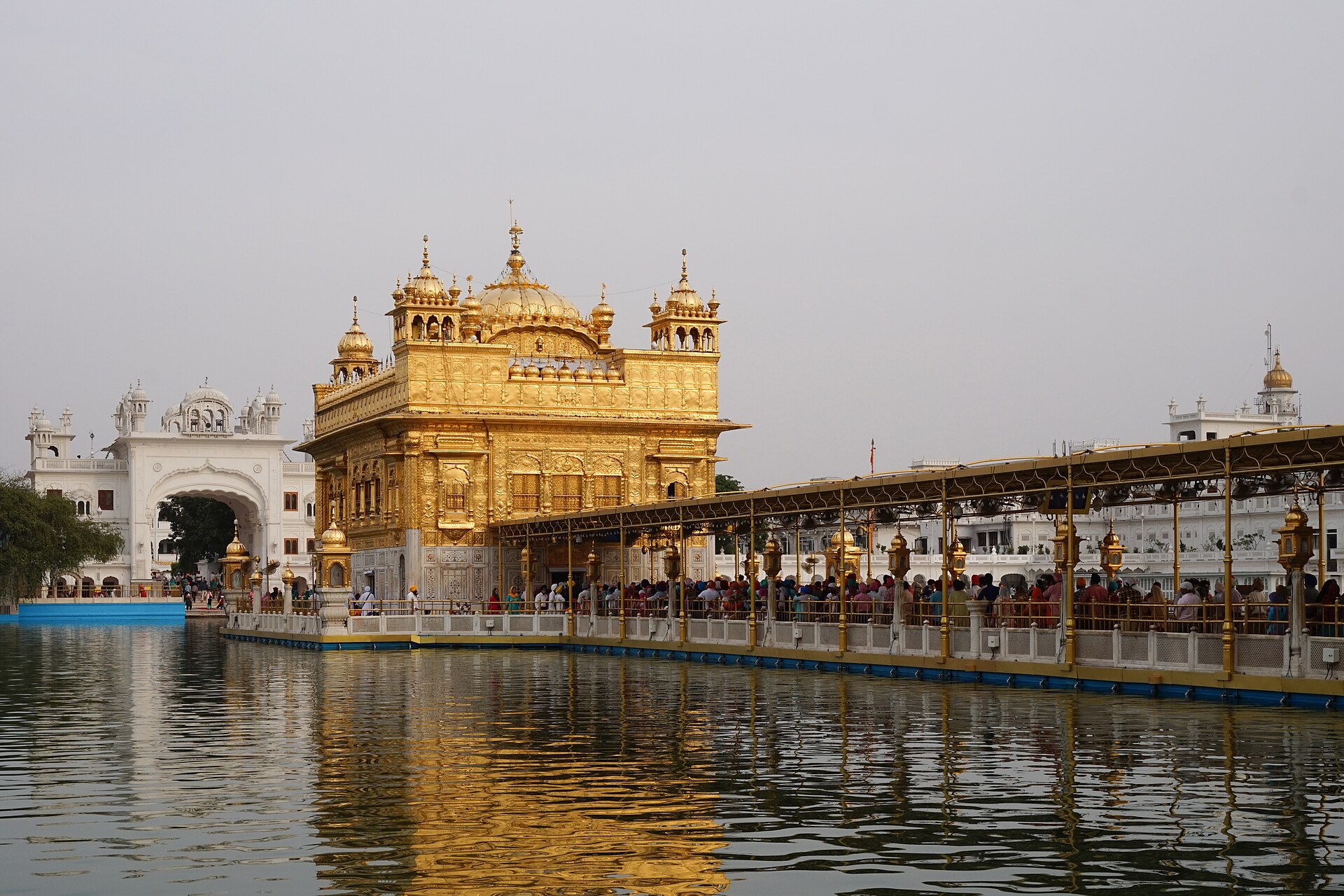
He founded the town that became Amritsar and dug the tank the Golden Temple now stands in. He also wrote the Lavan, so that Sikhs would stop borrowing a marriage rite from the neighbours.
Meet them — context →
G
Guru Nanak — the first light.
Emerged from the river after three days with one sentence — there is no Hindu, there is no Muslim — and walked four directions teaching it.
Meet them — context & 1 source →
G
Guru Hargobind — two swords.
He came to the seat at eleven, days after his father was tortured to death, and wore two swords to the ceremony: miri for worldly authority, piri for spiritual. Then he built the Akal Takht directly opposite the Harmandir Sahib, and the community has been arguing about the relationship between those two buildings ever since.
Meet them — context →
G
Guru Har Rai and Guru Har Krishan — the gardener and the child.
Har Rai kept a herb garden and a free dispensary that treated the emperor's own son, and disowned his elder son for altering a single line of Nanak's verse to flatter Aurangzeb. Har Krishan became Guru at five, nursed Delhi through a smallpox epidemic, and caught it himself at eight.
Meet them — context →
G
Guru Tegh Bahadur — the shield of India.
A delegation of Kashmiri Brahmins facing forced conversion asked him for help; he told them to inform the emperor that if he could be converted, they would follow. He was beheaded in Delhi in 1675 — a martyr for a religion that was not his own, which is why Sikhs call him the cloak of India.
Meet them — context →
G
Guru Arjan — sweet is Your will.
Compiled the scripture, built the Golden Temple, and accepted torture without resistance: the tradition's turn toward steel began with his peace.
Meet them — context & 1 source →
G
Guru Gobind Singh — the last human Guru.
Founded the Khalsa with five who offered their heads, lost four sons, and closed the succession by crowning a book.
Meet them — context & 1 source →
Saints & exemplars — lives held up as the pattern
T
The Panj Piare — five heads, five castes.
At Vaisakhi 1699 five men from five corners of India walked into the tent when the Guru asked for a head: a shopkeeper, a farmer, a water-carrier, a calico-printer and a barber. Then Guru Gobind Singh knelt in front of the men he had just made and asked them to initiate him in turn.
Meet them — context →
B
Bhagat Kabir — the weaver in the scripture.
A Muslim weaver of Banaras who mocked pandits and mullahs with equal appetite and died about fifty years before Nanak was born. Guru Arjan put 541 of his compositions inside the Sikh scripture — more than any Guru except Nanak and Arjan himself.
Meet them — context & 1 source →
B
Bhagat Ravidas — the city with no sorrow.
A leatherworker of the caste that Banaras treated as untouchable, with forty-one hymns in the Guru Granth Sahib. One of them describes Begampura, a city with no tax, no rank and nobody in second place — read in Punjab now as the oldest Dalit utopia in writing.
Meet them — context & 1 source →
S
Sheikh Farid and Bhagat Namdev — the Sufi and the calico-printer.
Farid's couplets, the oldest surviving verse in Punjabi, sit in the scripture as bani; Namdev, a Marathi tailor of the Varkari tradition, has sixty-two compositions. Neither was a Sikh, neither was posthumously converted, and the book carries them as they were.
Meet them — context & 1 source →
B
Bhai Mardana — the Muslim who carried the tune.
A Mirasi bard from Nanak's own village who travelled with him for nearly thirty years, playing the rabab while Nanak sang whatever came. Two of his own verses are in the scripture, and until 1947 the hereditary musicians of the Golden Temple were his Muslim descendants.
Meet them — context →
M
Mata Khivi — the one woman the scripture names.
Guru Angad's wife, who turned the langar from a gesture into an institution that could feed a town every day. Rai Balwand names her on Ang 967 as a good soul who spreads shade like a leafy tree — and no other woman is named anywhere in the book.
Meet them — context & 1 source →
M
Mai Bhago — the woman who turned the deserters back.
Forty Sikhs signed a paper renouncing the Guru and went home to Majha; Bhag Kaur shamed them into riding back, and fought beside them at Khidrana in 1705. She lived, became the Guru's bodyguard, and the forty are remembered as the Chali Mukte — the forty liberated.
Meet them — context →
T
The shaheeds — the martyrs named in the prayer.
Bhai Mati Das sawn in half in Delhi; Bhai Taru Singh's scalp cut away rather than his hair cut; Baba Deep Singh dead at Amritsar at seventy-five. Twice a day the Ardas recalls those who were cut apart limb by limb and scalped and never gave up their faith, which is how a small community keeps a very long memory.
Meet them — context →
M
Mata Gujri and the four Sahibzade.
Ajit Singh and Jujhar Singh died fighting at Chamkaur; Zorawar Singh and Fateh Singh, nine and six, were bricked into a wall at Sirhind for refusing to convert. Their grandmother Mata Gujri, held through December in an open tower, died the same week — and Punjab keeps that week every year in the coldest part of winter.
Meet them — context →