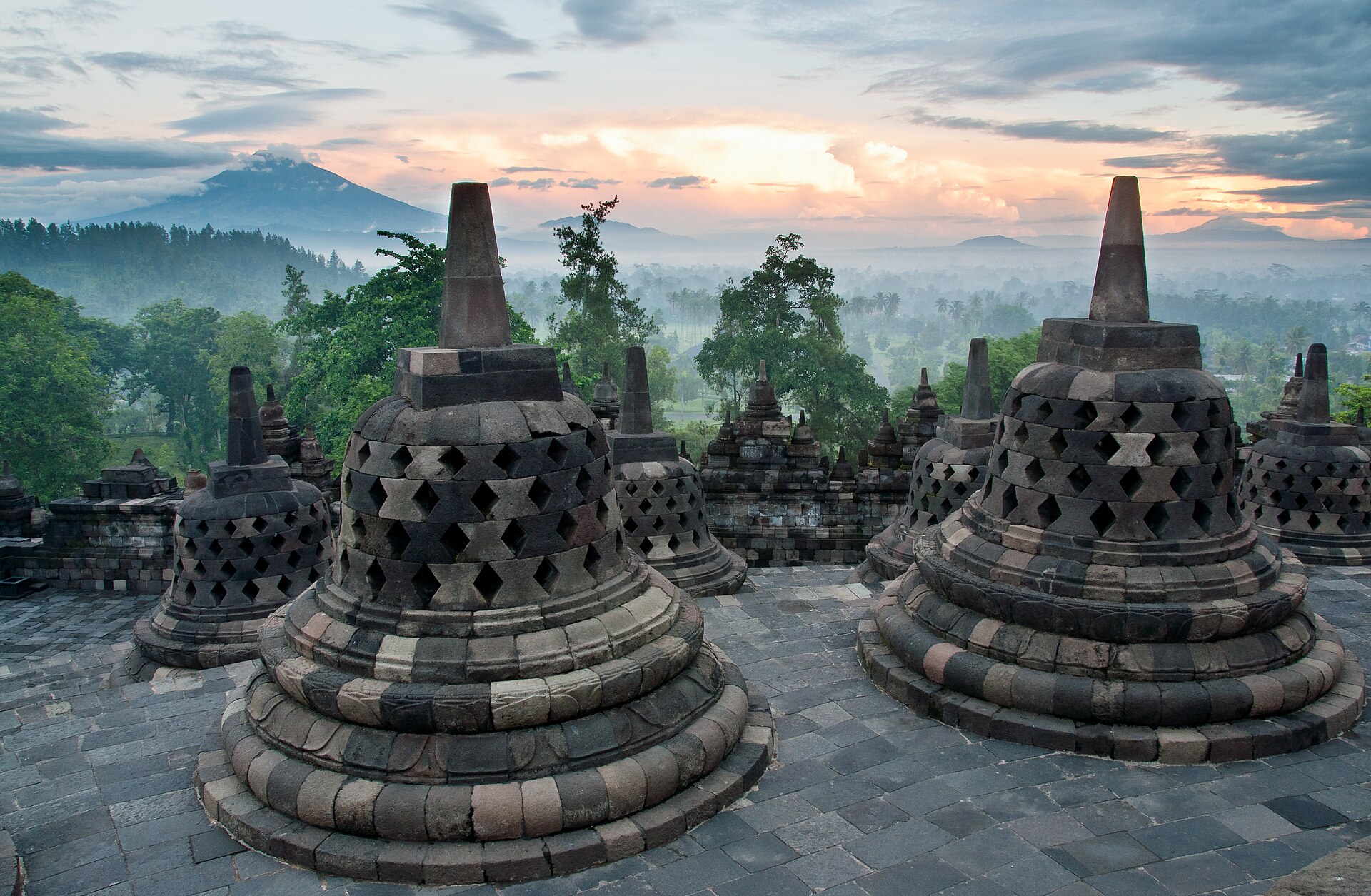
Borobudur at sunrise · Justine Hong · CC BY 2.0

Buddhism

Tradition·Founded c. 480 BCE·est. ~500 million worldwide

Vedic Religion → Buddhism → 3 branches

Branch
V Figure of Buddhism

Vairocana — the cosmic buddha.

Not a teacher who lived and died but the dharma with a face: the sun-buddha at the center of the mandala, whom Nara cast in bronze and Shingon made the ground of everything.

Names & titlesVairocana — Dainichi Nyorai, Birushana, Nampar Nangdze
DomainThe dharmakaya — reality itself, wearing a body
RelationsThe five buddhas of the directions radiate from him
Depicted asWhite or gold, hands turning the wheel, at the dead center of the mandala
StandingThe ground of Shingon and Huayan; the fifteen-metre Great Buddha at Nara is him
Understanding it — context, not catechism: how this passage is held

Vairocana is what happens when a religion decides its founder was a local appearance of something much larger. The dharmakaya — the "truth body" — is reality as such, and Vairocana is that given a form to face. Huayan in China made him the center of a universe in which every particle reflects every other; Shingon in Japan made him the one whose body, speech and mind the practitioner enacts directly with mudra, mantra and mandala. The Great Buddha at Todai-ji is Vairocana, and its scale was the point: an eighth-century emperor casting the cosmos in bronze at national expense.

The same ground, other faiths

claims that share this one's ideas
Salt in the water. Hinduism · story Read it in full →
K Kundakunda. Jainism Meet them →
God contracted to make room for the world. Judaism · core tenet Go deeper →
Fana. Islam · the interior Go deeper →
What you are is not the body, and it goes back to the Source. The Order of the Solar Temple · core tenet Go deeper →
The Force is real and it is not a person. Jediism · core tenet Go deeper →

The conversation

argument stays attached to the claim it is about All discussion →

Sign in to open the first thread. Everything here is attributed.

Built on Hatchable