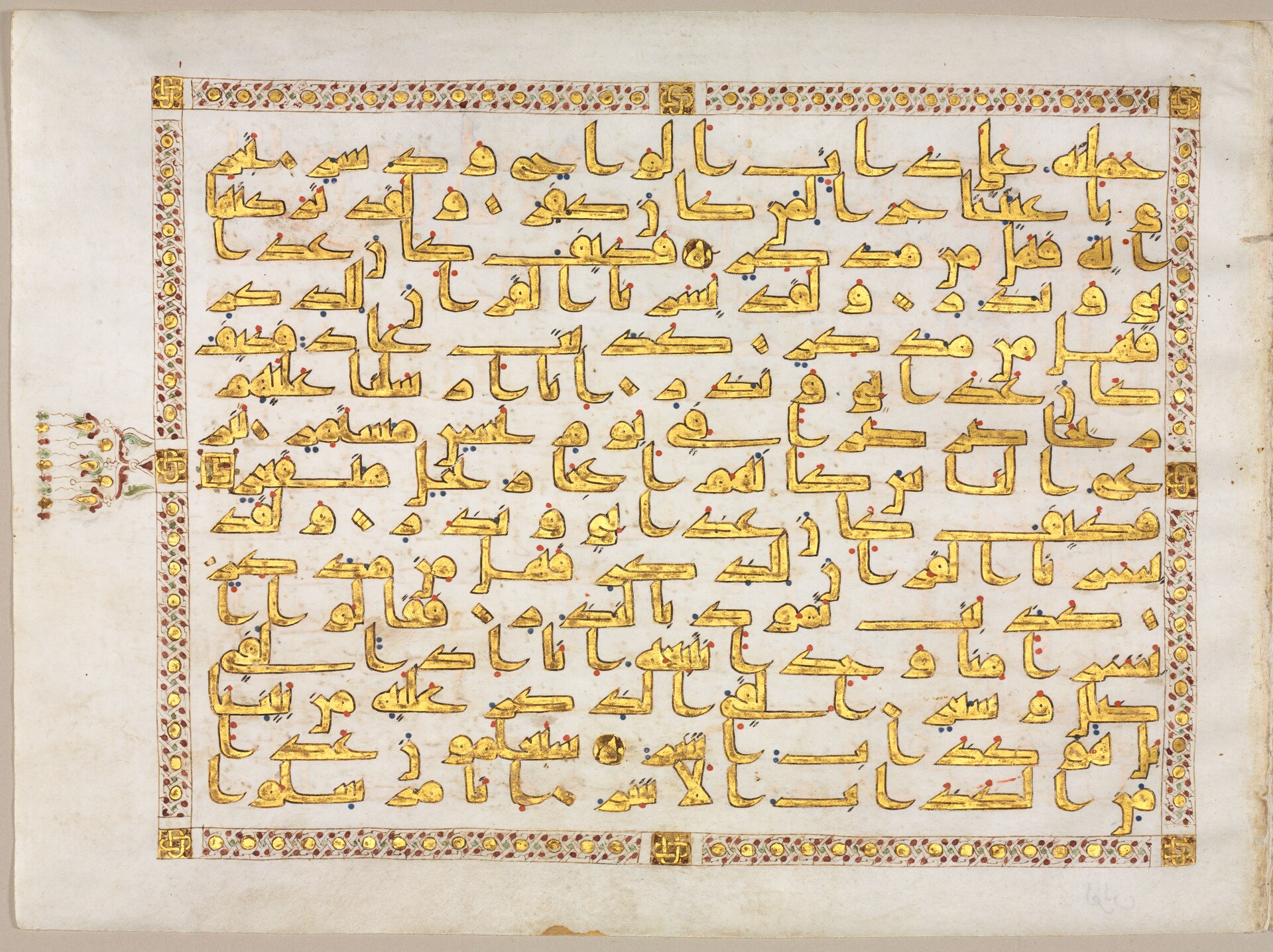
Tajwid, and the ten readings.
The Quran is not read, it is recited, to rules governing vowel length, nasalisation and where the voice may stop. There are ten canonical readings, differing in vowels and occasionally in a word, all considered equally the Quran — a fact that surprises people who expect a single fixed text.
Open the book — context →
The Quran.
For Muslims, God's speech verbatim — recited before it was ever a book.
Open the book — context →
The hafiz.
The whole book — about 6,236 verses — carried in memory, with a chain of teachers behind it. Millions of people hold it, many of them children, and Indonesia, Egypt, Turkey, Nigeria and Iran run competitions for it on national television. It is the reason the text has a second, independent transmission line.
Open the book — context →
The Hadith collections.
The Prophet's words and deeds, sifted and graded — the sunna made searchable.
Open the book — context →
The four books.
Al-Kafi, Man la yahduruhu al-Faqih, Tahdhib al-Ahkam and Al-Istibsar — the Twelver Shia hadith corpus, compiled in the ninth to eleventh centuries. Much of the content overlaps the Sunni collections; almost none of the chains do, because the two traditions disagree about which of the first generation to trust.
⚖ contested within
Open the book — context →
Nahj al-Balagha.
The sermons and letters attributed to Ali, collected around 1010. The letter of instruction to Malik al-Ashtar on governing Egypt is read as a manual of just administration well outside Shia circles, and the Arabic itself is taught as a model of prose. Some Sunni scholars dispute the attribution.
⚖ contested within
Open the book — context →
The sira.
Ibn Ishaq wrote the life of the Prophet in the eighth century and it survives mainly through Ibn Hisham's edited version, which states plainly that material was left out as objectionable. Nearly every story Muslims tell about the Prophet comes through this book, and historians have been arguing about the editing for twelve hundred years.
held by most
Open the book — context →
Tafsir.
Verse-by-verse commentary — al-Tabari's runs to thirty volumes and quotes everyone he disagrees with. Which tafsir a mosque or a family uses is a sharper indicator of where they stand than which school they name, and the twentieth-century Urdu and Indonesian commentaries reshaped the religion for hundreds of millions.
held by most
Open the book — context →
Usul al-fiqh — the roots of the law.
Al-Shafii's Risala set out how you get from a text to a ruling: Quran, then the practice of the Prophet, then consensus, then analogy. Once the method is explicit, disagreement becomes legitimate — which is why four Sunni schools can give four answers and all four are orthodox.
held by most
Open the book — context →
The Mathnawi.
Twenty-five thousand Persian couplets, opening with a reed cut from the reed bed and complaining about the separation. Rumi's admirers called it the Quran in Persian; his critics thought that was exactly the problem. It is recited, sung, and danced to in the Mevlevi ceremony.
⚖ contested within
Open the book — context & 1 source →
Ihya Ulum al-Din.
Al-Ghazali left the most prestigious chair in Baghdad, disappeared for eleven years, and came back with forty books on how to pray, eat, marry, earn and die. It is the most widely read Islamic book after the Quran and the hadith, and it is what made Sufi practice respectable to the jurists.
held by most
Open the book — context →
Translation, and the argument about it.
Most of the world's Muslims do not read Arabic, and the tradition holds that the Quran in another language is not the Quran — the standard title is an interpretation of the meanings. So the book people actually read is a rendering with the Arabic beside it, and which rendering carries real theological weight.
⚖ contested within
Open the book — context →