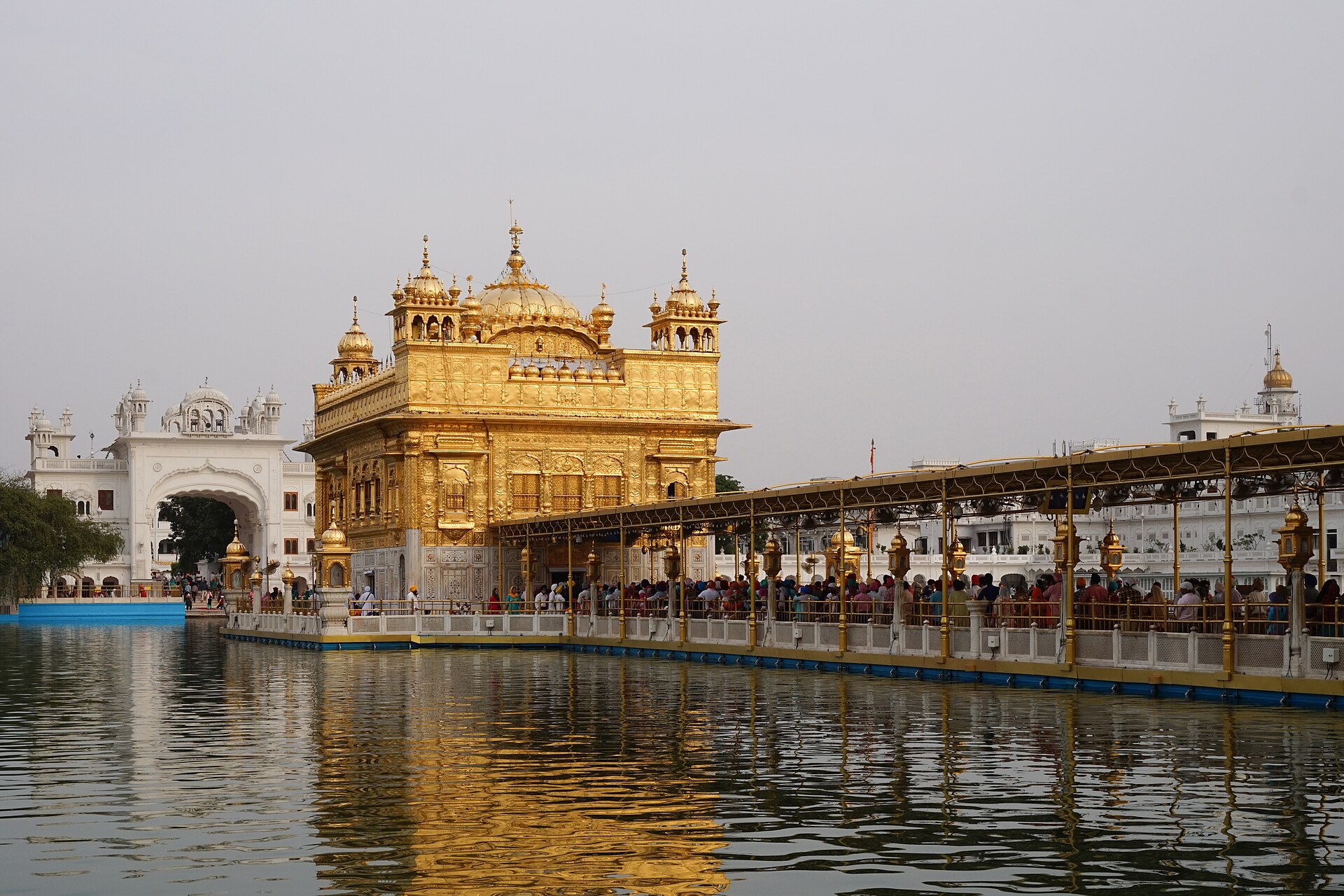
Daily
Amrit vela — the hours before dawn.
The scripture names the last watch of the night as the time to sit with the Name, and Sikh discipline takes it literally: up at three or four, cold bath, then Japji. It is the single hardest thing the tradition asks of an ordinary person, and the thing lapsed Sikhs most often say they miss.
Go deeper — context →
Kirtan Sohila — the last five hymns.
Said lying in bed at the end of the day, and said again over a body before it is burned. A Sikh hears the same words at the close of every day of their life and then once more, which is the tradition's entire theology of death in a scheduling decision.
Go deeper — context →
Langar — the free kitchen.
Anyone eats, everyone sits on the same floor, volunteers cook and serve — equality made edible.
Go deeper — context →
Ardas — the standing prayer.
Everyone rises, and the prayer runs through the ten Gurus, the martyrs, the shrines, then finally the specific request — a sick relative, a driving test, a new shop. It ends by asking for the good of all people, not only Sikhs, and any Sikh present may lead it.
Go deeper — context & 1 source →
The hukamnama — opening the book at random.
The scripture is opened without looking and the hymn at the top of the left page is read as the order of the day. Gurdwaras post it every morning, families take one before a journey or a wedding, and the Golden Temple's is broadcast worldwide before dawn.
Go deeper — context →
Crossing the threshold.
Shoes off, feet washed, head covered, forehead to the floor, coin in the box, and then sit on the floor with everyone else — no chairs, no pews, no reserved rows. The four doors of the Harmandir Sahib state the rule architecturally: enter from any direction, and walk down rather than up.
Go deeper — context →
Karah prasad.
Flour, ghee and sugar in equal weight, stirred in an iron pan while gurbani is recited, then given into cupped hands at the end of every service. It is served in the order people are sitting, and refusing it is not really an option — that is what it is for.
Go deeper — context →
Prakash and Sukhasan — the Guru wakes and sleeps.
At dawn the scripture is carried on someone's head to a canopied throne, opened, and fanned with a whisk all day; at night it is wrapped and carried to its own room, where it has a bed. Sikhs describe this as the courtesy owed a living sovereign, and reformers inside the Panth ask, regularly, where the line to idolatry now sits.
Go deeper — context →
Nitnem — the daily banis.
Five prayers in the morning, one at dusk, one before sleep: the day framed in recitation, beginning with Japji before dawn.
Go deeper — context →
Tying the dastar.
Five to seven metres of cotton, wound fresh every morning in front of a mirror over hair that has never been cut. Styles are regional and readable — the sharp Kenyan-Punjabi peak, the round Patiala shahi, the Nihang's towering dumalla, the smaller patka a boy wears until he learns.
Go deeper — context →
Kirtan — the Granth, sung.
The scripture is a songbook: every shabad carries its raga, and the harmonium and tabla are how the Guru's words are actually met.
Go deeper — context →
The gutka on the shelf.
A small cloth-wrapped book of the daily banis, kept high, opened with the head covered and hands washed. Households with the space keep a full Guru Granth Sahib in its own room with a bed and a canopy — an obligation serious enough that most families deliberately do not take it on.
Go deeper — context →
Weekly
The diwan — the gurdwara service.
Kirtan, then katha, then Anand Sahib, Ardas, the hukamnama, prasad, and langar — the same shape in Amritsar, Southall and Surrey. Sikhism has no sabbath: Sunday morning is a diaspora convenience, and in Punjab the gurdwara simply runs from before dawn until late.
Go deeper — context →
Yearly
Bandi Chhor Divas.
The night Guru Hargobind walked out of Gwalior fort with fifty-two princes holding his cloak, which happens to fall on Diwali. Sikhs light the Golden Temple to the waterline and are careful to say what they are celebrating, because the coincidence has been used to fold them into someone else's festival.
Go deeper — context →
Hola Mohalla.
Guru Gobind Singh took the spring festival of coloured water and turned it into three days of mock battle at Anandpur Sahib. Nihangs ride bareback, fight with gatka, and split coconuts at a gallop; about a million people come, and the roadside langars run continuously.
Go deeper — context & 1 source →
Gurpurabs and the nagar kirtan.
The Gurus' birth and martyrdom days, each opened by a forty-eight hour reading and closed by a procession through the streets behind five men in saffron and the scripture on a decorated float. Volunteers sweep the road ahead of it, and stalls hand food to anyone standing on the pavement, Sikh or otherwise.
Go deeper — context →
Maghi at Muktsar.
Mid-January, freezing, and hundreds of thousands bathe in the tank at Sri Muktsar Sahib where the forty deserters died fighting. Attached to it is one of the largest cattle and agricultural fairs in Punjab, which nobody finds contradictory.
Go deeper — context →
Vaisakhi.
The harvest festival Guru Gobind Singh chose for the Khalsa's founding: the day the community celebrates becoming visible.
Go deeper — context →
Once in a life
Amrit — the nectar initiation.
Sweetened water stirred with a double-edged sword; the initiate joins the Khalsa and takes its discipline.
Go deeper — context →
Akhand Path — forty-eight hours, unbroken.
The entire 1,430 pages read aloud without a pause, readers relieving each other every couple of hours, ending on a chosen morning with the bhog. It is commissioned for deaths, births, house moves, exam results and business openings, and the fee charged by professional readers is one of the things reformers complain about loudest.
Go deeper — context →
Naam karan — the naming.
The family brings the newborn, the scripture is opened at random, and the child is named with a word starting with the first letter of that hymn. Then Singh or Kaur is added — the shared surnames Guru Gobind Singh gave so that no one could read a caste off a name.
Go deeper — context →
Anand Karaj — the four rounds.
The couple circle the Guru Granth Sahib four times while Guru Ram Das's four Lavan are read and then sung, and that is the whole marriage. No fire, no priest, no astrologer, no dowry — and no bride given away, since the rite has no giver.
Go deeper — context & 1 source →
Antam Sanskar — the last rite.
The body is washed, dressed in the five Ks, and cremated, usually within a day; Kirtan Sohila is recited, Ardas is said, and a complete reading of the scripture is finished within about ten days. The Rehat Maryada forbids raising any monument over the ashes, which is why Sikh cemeteries barely exist.
Go deeper — context →
Ongoing
The sarovar at Amritsar.
Four doors, steps leading down rather than up, a marble walkway, and a tank people bathe in at any hour of the night. The langar there feeds somewhere upward of fifty thousand people a day and more on festivals, and it has never charged or checked anyone.
Go deeper — context →